Bank of England Five Pound Note, January 1, 1855. (Richard Kelly)
Session I, Panel 2. “The Anatomy of a Banknote: 1855 Innovations in Design, Papermaking, and Printing,” presented by Richard Kelly and “Calendered Paper, Electrotyping, Hard-Packing and Late Nineteenth-Century “Fancy Type Faces,” presented by Michael Knies. [Read more]
Session III, Panel 3. “The Conversation Between Paper and Printing in Contemporary Artists’ Books,” presented by Inge Bruggeman ¶ “Material of the Margins: Handmade Paper in Artist’ Books,” presented by Tatiana Ginsberg ¶ “Size Matters,” presented by Kitty Maryatt.
One of a Thousand Fires, 2006. Poems by Cissy Ross, book design, images, printing and binding by Inge Bruggeman.
Inge Bruggeman‘s talk began by focusing on the relationship between ink on paper and questioned our culture’s confidence in its permanence in our environment. Given advances in technology and the ways in which we interact and communicate, she asked how long will paper and text last? Will it stay forever? The printed page can be seen now as a nostalgic place to hold ideas. Paper and printing are being pushed towards objectification and art rather than everyday events and objects. What is the relevance of paper in general and the relevance of paper in artists’ books? There are still elements of culturally relevant paper, such as a receipt roll from a grocery store, as well as ramifications of shifting away from paper based environments. Inge noted her concern about the future of the archive. Will there be an impact on the scholarly record when studying or doing research from disc or flash drives? [Read more]
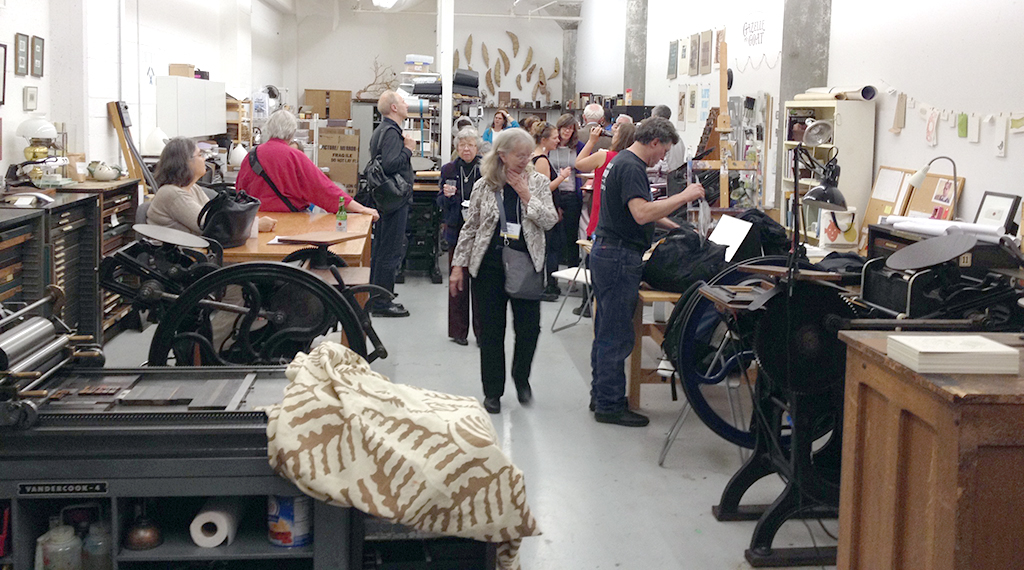
Visitors explore Studio 308 on Friday, October 17. (Paul Romaine)
1890 Bryant Street Studios hosted an open studio for conference members on Friday afternoon, followed by a reception for the Friends of Dard Hunter Members’ Exhibition. The Best Foods Building, an historic warehouse located in the Mission District of San Francisco, is home to an array of artist’s spaces, including one book arts studio. [Read more]
We walked up to the imposing building on Funston Street in San Francisco adorned with tall Greek columns, wondering how this could be the home of the digital empire called the Internet Archive. Formerly a Christian Scientist church, this classical edifice was repurposed as a repository of knowledge, free to everyone. Founded in 1996, the Internet Archive is a non-profit, digital library which provides free access to a combined eleven million texts, audio recordings and live music concert recordings, plus 435 billion web pages. In addition to developing their own collections, the Archive is working to promote the formation of other Internet libraries in the United States and elsewhere. [Read more]
Any letterpress enthusiast visiting San Francisco will want to make the effort to visit Arion Press and M&H Type located in the Presidio. Founded in 1974 by publisher-designer Andrew Hoyem, Arion Press produces two to three limited editions per year employing craftsmanship in the fine printing tradition. Augmented by M&H Type, it is a full-service operation creating exquisite works and creative collaborations with many contemporary artists. The Grabhorn Institute is the nonprofit umbrella organization. [Read more]
Twinrocker Handmade Paper: A Chunk of San Francisco in a Hoosier Cornfield.
Kathryn and Howard Clark, Brookston IA, ca. 1990s. (Todd Matus).
REVISED. Twinrocker Handmade Paper began in San Francisco in 1971. Then in 1972, Kathryn and Howard Clark relocated to Brookston Indiana where it thrives today. On Thursday October 16 at the Internet Archive the Clarks gave the Keynote speech to an attentive audience. This nostalgic lecture focused more on the people who encouraged and inspired them than on their own impressive accomplishments. [Read more]
Session II, Panel 1. “Printing by Hand in Asia,” presented by Steph Rue, Radha Pandey and Elizabeth Boyne.
Hemp fabric, soaked in a slaked-lime solution and beaten by hand for 15 minutes. (Elizabeth Boyne)
Archeologists found the first and oldest piece of paper recorded in Asia dates from the Western Han dynasty around 105 CE. Made of hemp it was very crude. Peasants were encouraged to grow grains during the Han dynasty, one being hemp. In early paper making women soaked hemp in water and beat it on wash blocks of stone. Does this mean women invented paper? [Read more]
Jon Hook and Andrea Peterson, Sculptural Forms: Casting Pulp in Ceramic Molds.
Detail of final sheet (with incorporated print) cast in half-round corn-cob mould. (Alta Price)
Ceramicist Jon Hook and papermaker Andrea Peterson of Hook Pottery Paper gave an engaging demo on how to make both the paper and moulds for casting a variety of objects. Jon and Andrea covered clay selection; mould creation; sheet formation using a deckle box; light pressing, by hand, of freshly formed sheet; inclusion of printed imagery into final cast, akin to a 3-D version of chine collé with relief prints on a variety of papers; and casting and removal of final paper object. [Read more]
Session II, Panel 4. “The Paper Artist & the Engineer: How Technology Supports the Creative Process,” presented by Brian Queen ¶ “Flax: The Printer’s Plant,” presented by Josef Beery ¶ “Pulp Diction,” presented by Amy LeePard and Suzanne Sawyer.
Laser Cutting Fine Binding, Artist Monique Lallier, Interpreter of Maladies. (Brian Queen)
Brian Queen started off this sparkling panel with his presentation, “The Paper Artist & the Engineer: How Technology Supports the Creative Process.” He amply demonstrated that new digital technologies have presented book artists and designers with amazing new tools: laser cutters, CNC routers, and 3-D printers are capable of more than you might imagine. The talk was supplemented with several short “demo” videos, and a parade of artifacts that were passed through the audience. Queen pointed out that throughout history, artists have been among the first people to exploit new technologies. [Read more]
The Drinkable Book is a manual that provides safe water tips, printed in non-toxic, food grade ink on paper coated with silver nanoparticles, which kills water-borne diseases like cholera, E. coli and typhoid. Each book is 25 pages, and each page filters water for about 6 months – giving people who receive it tools to have clean water for about 12.5 years. (Jamie Mahoney)
Session III, Panel 4. “Printing the Drinkable Book: Advances in Paper in the Twenty-First Century,” presented by Jamie Mahoney” ¶ Divers Digital Desiderata: Explorations in Digital Printing,” presented by John Labovitz ¶ “Hand Papermaking & the Printed Word: Dynamic Tools for Healing,” presented by Amy Richard. [Read more]