
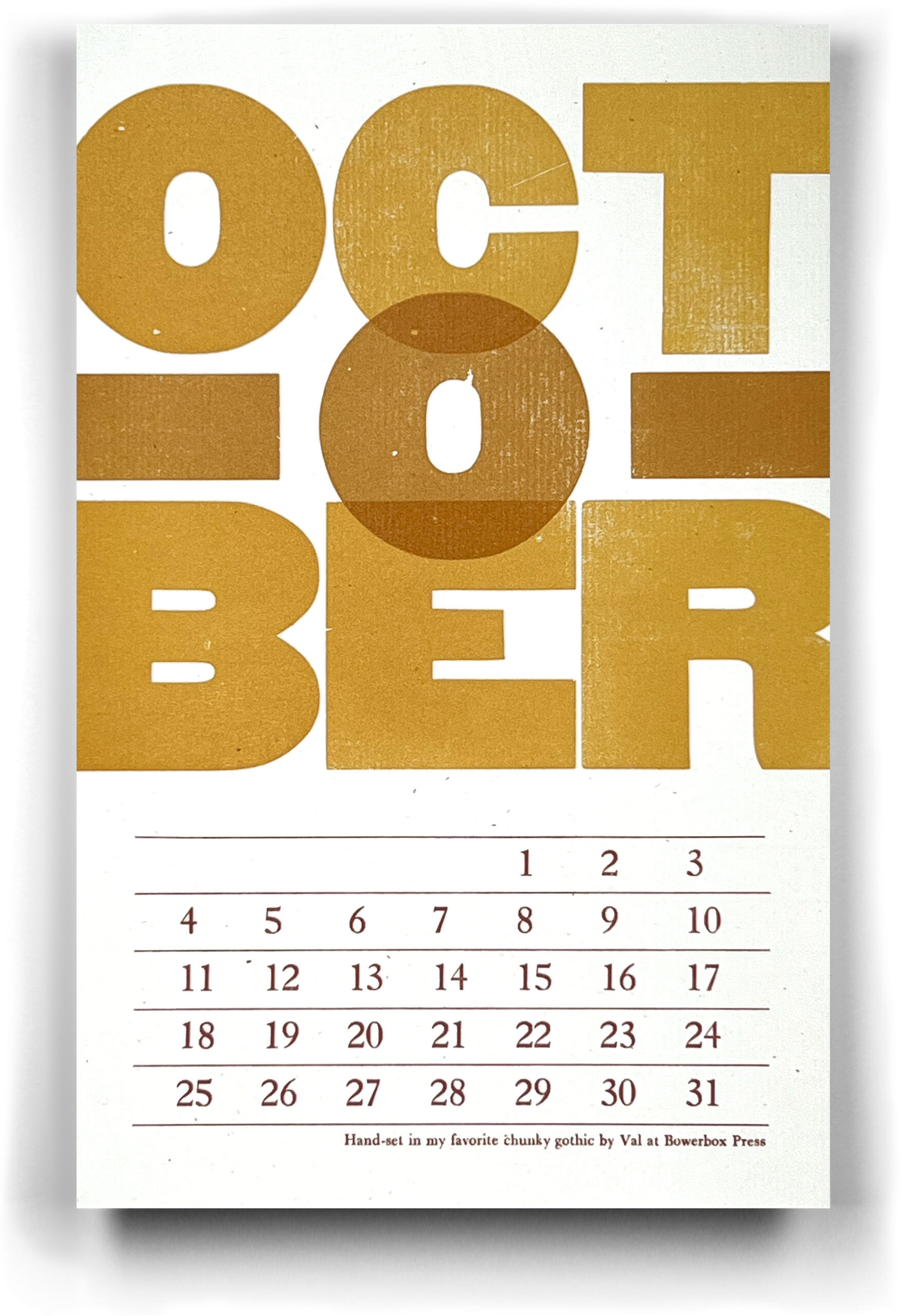
October 2026 APHA chesapeake calendar page
Val Lucas, Bowerbox Press, Monkton, Maryland.
Handset wood & metal type. Printed in 3 colors.

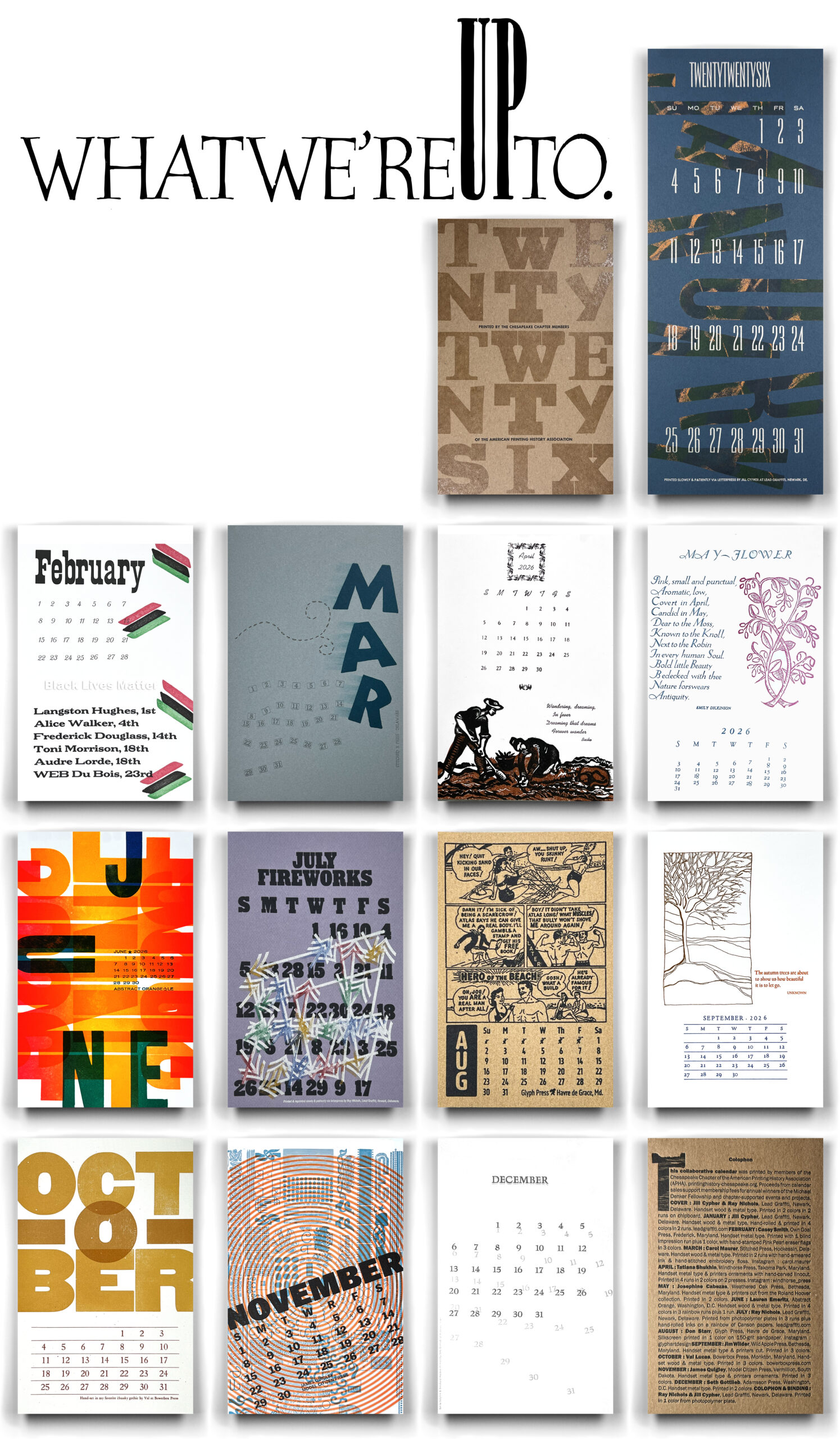
APHA 2027 collaborative calendar.
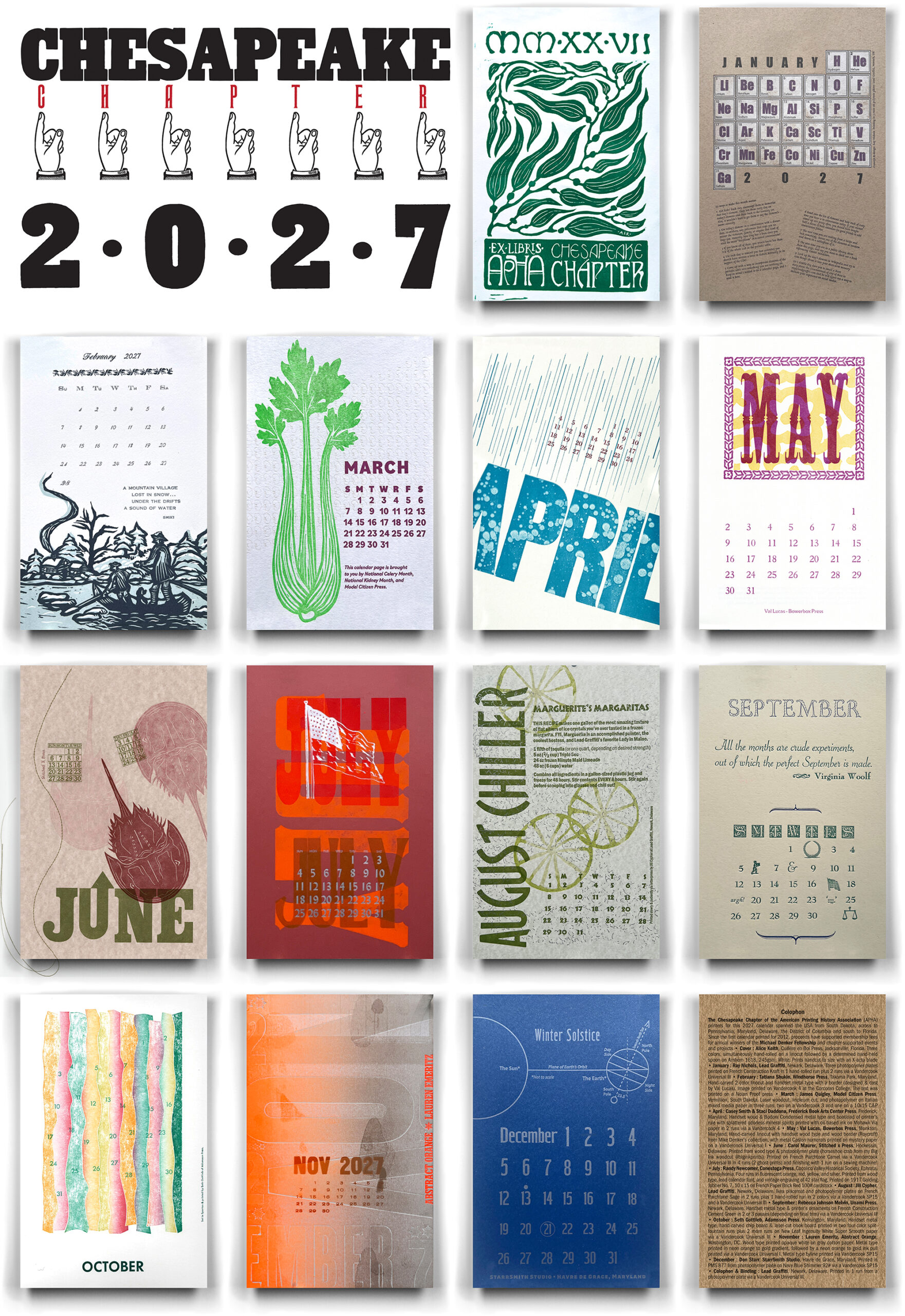
Cover / Alice Keith, Cuillère en Boi Press, Jacksonville, FL
January / Ray Nichols, Lead Graffiti, Newark, DE
February / Tatiana Shukhin, Windhorse Press, Tacoma Park, MD
March / James Quigley, Model Citizen Press, Vermillion, SD
April / Casey Smith, Frederick Book Arts Center, Frederick, MD
May / Val Lucas, Bowerbox Press, Monkton, MD
June / Carol Maurer, Stitched Press, Hockessin, DE
July / Randy Newcomer, Ephrata, PA
August / Jill Cypher / Lead Graffiti, Newark, DE
September / Rebecca Johnson Melvin, Newark, DE
October / Seth Gottleib, Adamsson Press, Washington, DC
November / Lauren Emeritz, Abstract Orange, Washington, DC
December / Don Starr, Glyph Press, Havre de Grace, MD
Colophon / Lead Graffiti, Newark, DE
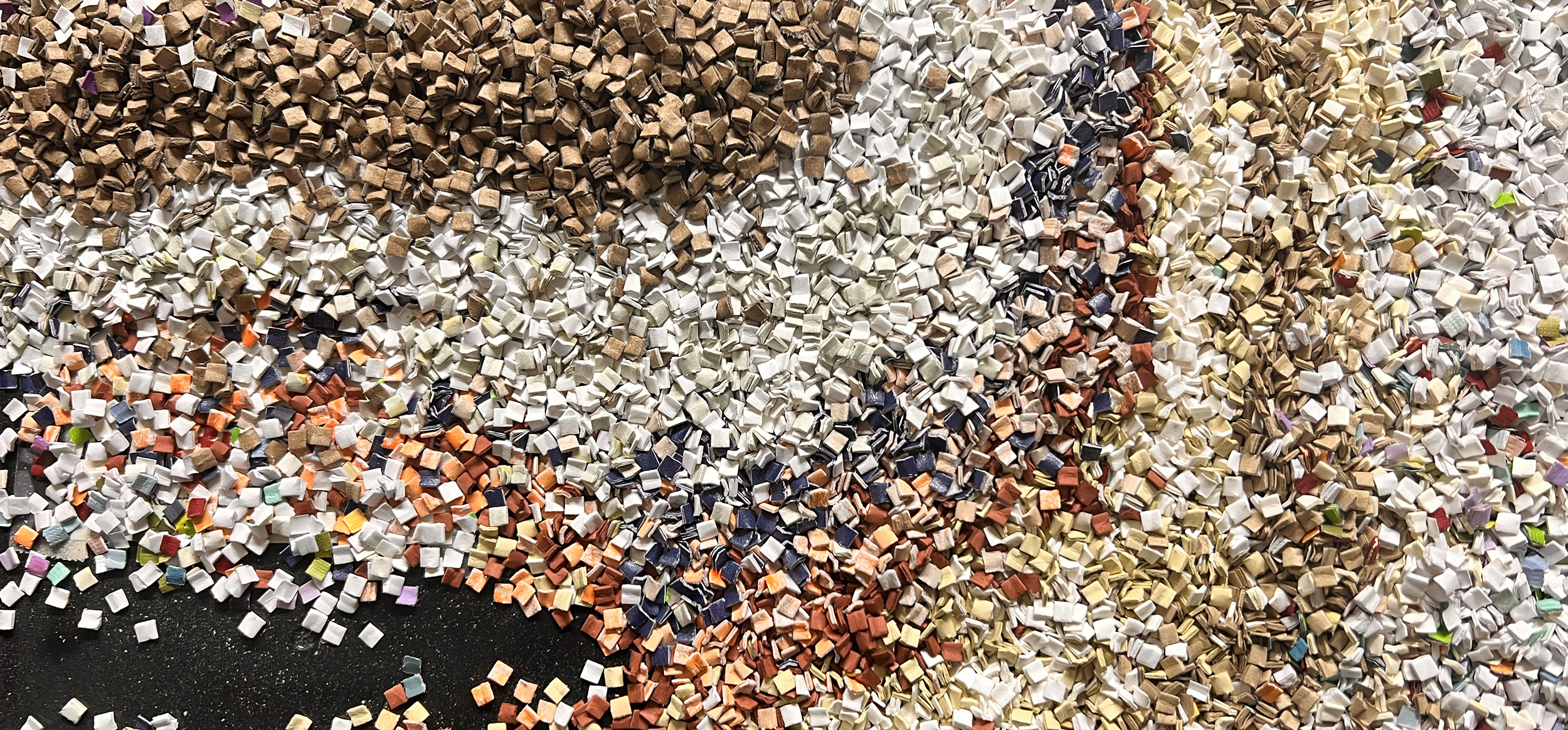
A pretty fair percentage of the 19,040 holes the Chapter punched for our 2027 calendar’s double-wire binding.
Frederick Book Arts Center
First Saturday
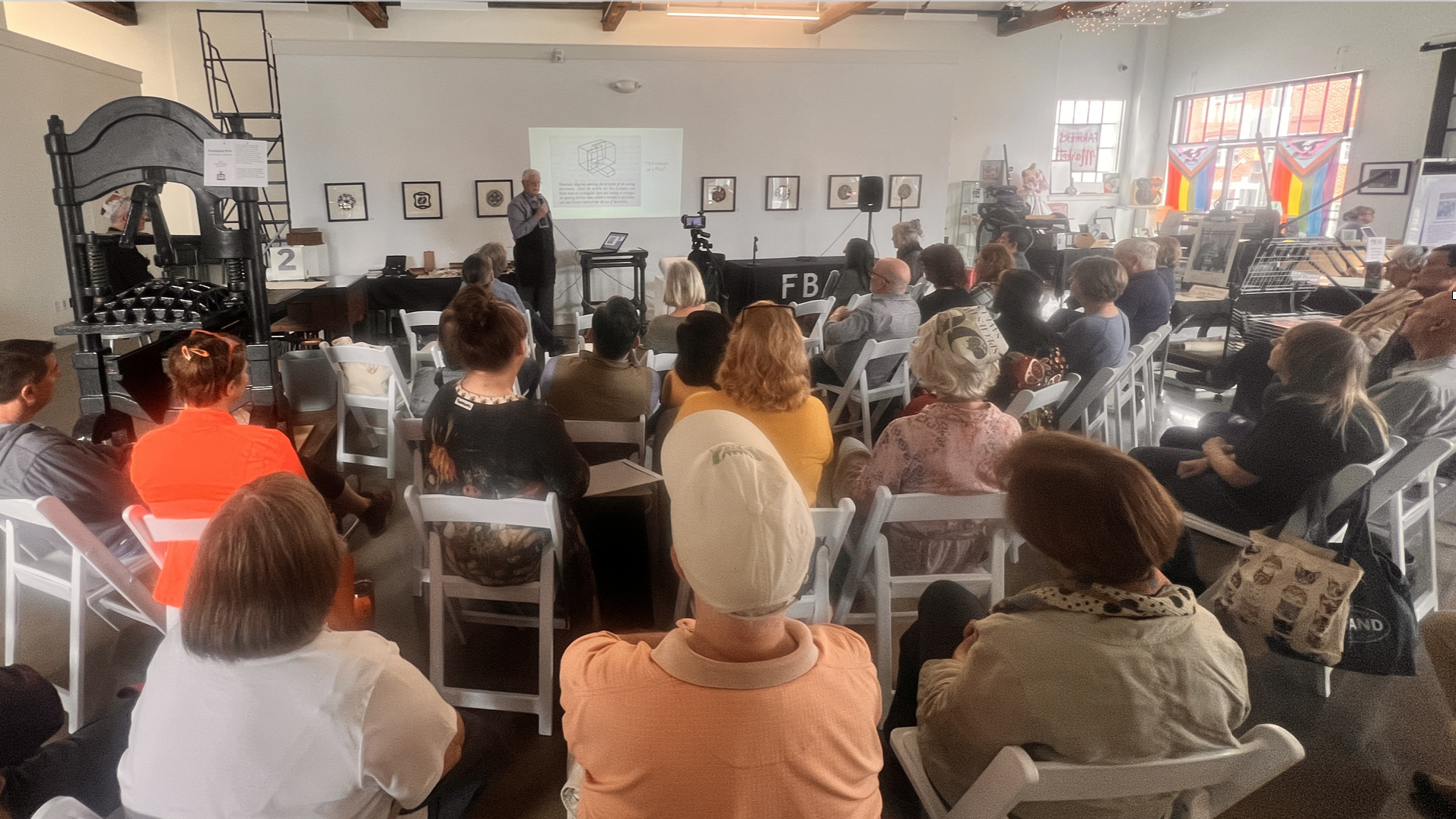
A great day of demonstrations, exhibitions, and talks, all tied to APHA. Casey Smith is the Executive Director of the Frederick Book Arts Center. Ray Nichols & Jill Cypher of Lead Graffiti in Newark, DE, did one of their H.N. Werkman workshops for a couple of dozen people. Stan Nelson gave a talk on his new book and his history of designing and making typecasting hand molds, and he demonstrated the process. APHA members Kerry McAleer-Keeler of George Washington University, Jackie Coleburn of the Library of Congress, Rare Books and Special Collections, Steve Heaver of Hill Press, Jill Cypher, and Ray Nichols of Lead Graffiti served on a 6-person panel discussion about their letterpress experiences.
This image shows part of the crowd of 65+ attendees at the Stan Nelson talk. Overall, there were 175 attendees for all sessions.
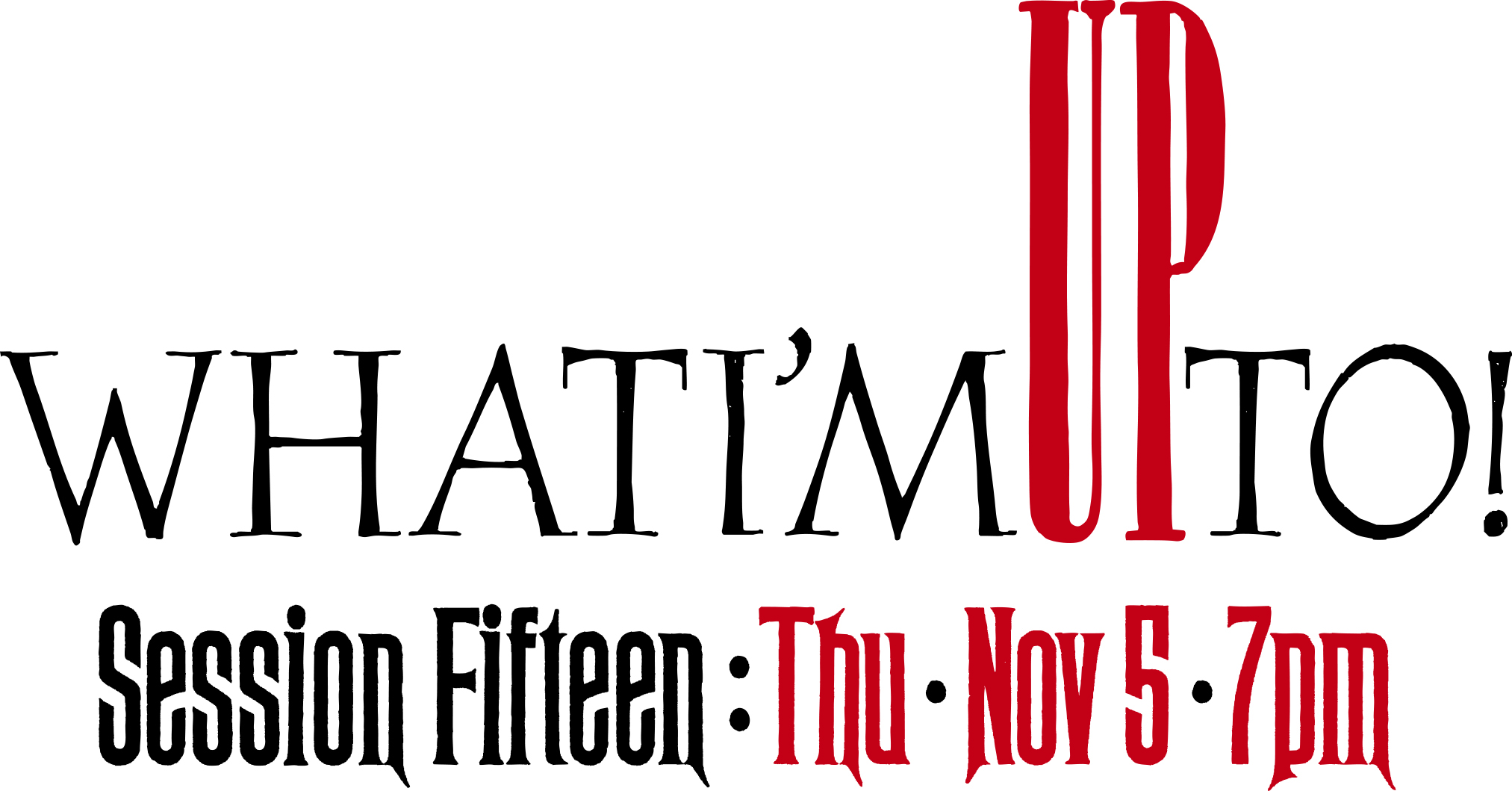
A Zoom meeting is typically scheduled within the first 7 days of every month for anyone interested in talking about what they are up to. Join us. The day of the week rotates from Monday to Thursday. You don’t have to be an APHA member. The discussion focuses on any issues related to the basics of the American Printing History Association. You’re free to just listen. Each individual’s session is ideally limited to 8-10 minutes per topic and discussion. You can cover more than one topic. Anything you’ve produced. Maybe an interesting article you read or a book cover you’ve seen. Can you only be there for a short time? Email Ray Nichols, and he’ll know you’ll be there early. Don’t feel bad about needing to leave the discussion. Register & sign in at the URL below.
Please add to your calendars: “What I’m UP to” through the end of the year is Wednesday, October 7; Thursday, November 5; and Monday, December 7. Dates are always open to change if we hear enough complaints
https://printinghistory-org.zoom.us/meeting/register/0fJhwcqQTVeTq1oLeOB6DQ
Gateway Open Studio
https://www.gatewaycdc.org/ost2026

Creative work by Chesapeake Chapter members
We are taking a stab at creating a series of pages featuring up to 5 examples of creative endeavors of our chapter members, past & present, who print or make books. As I (Ray Nichols) am the one heading this project, I’ve gone pretty deep into my page to show others how it might look. You can see a list of likely personalities. If you’d like to be included, email Ray Nichols.
In the #49 journal of the Fine Press Book Association there were two chapter members mentioned. President Lauren Emeritize was highlighted in “Recentely noted” and in the caption of a photo of the opening meeting of the organization 25 years ago, sitting right in the front middle, was Steve Heaver.
Chesapeake Chapter of the
American Printing History Association
Co-sponsored a Library of Congress event
with the William Morris Society of the US
honoring William S. Peterson & William Morris
on Friday, March 13, 2026
 .
.
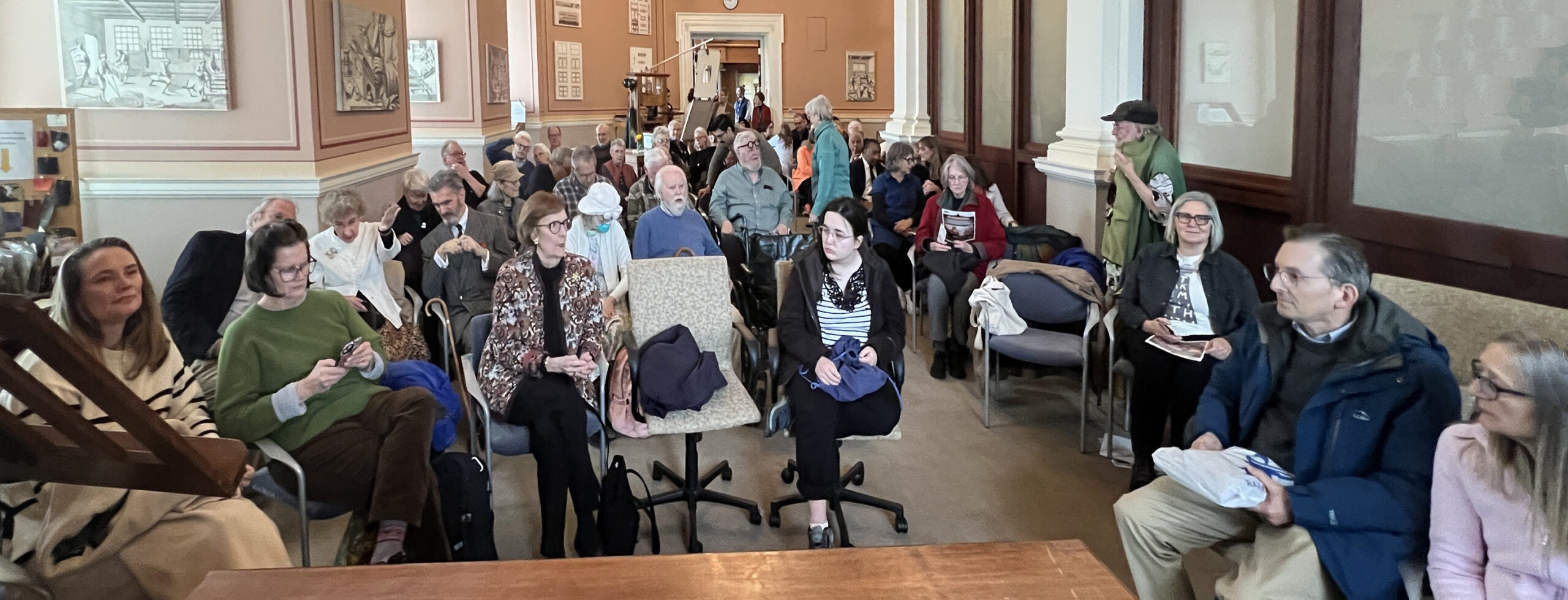
More people than the room could hold met at the Library of Congress on March 13 to celebrate the research life of William Peterson. The event was sponsored by the William Morris Society of the U.S. and the Library of Congress.
Stephanie Stillo, chief of Rare Books at the LCJ, and Jude Nixon, former president of the William Morris Society of the U.S., gave introductory remarks.
Caseey Smith, Executive Director of the Frederick Book Arts Center, presented a talk, “The Kelmscott Press in America: 150 Years of Adoration, Emulation, Condemnation, and Complication,” which will be followed by a special display of Kelmscott Press books from the Library of Congress’s collection.
Before the main talk, Seth Gottlieb led an informal tour of the exhibitions and newly formed Press Room at the Folger Shakespeare Library
William S. Peterson’s contributions make him one of the most significant historians of the book of our time. Now Emeritus Professor of English at the University of Maryland, Peterson is best-known for his work on William Morris, with A Bibliography of the Kelmscott Press (1984) and The Kelmscott Press: A History of William Morris’s Typographical Adventure (1991) universally recognized as definitive. Peterson supplemented these with The Ideal Book: Essays and Lectures on the Arts of the Book by William Morris (1982), The Kelmscott Chaucer: A Census (2011), written with his late wife, Sylvia Holton Peterson, and an edition of Morris’s A Note on his Aims in Founding the Kelmscott Press (1996). Of many other publications about books and printers we may mention John Betheman: A Bibliography (2006), The Beautiful Poser Lady: A Life of Ethel Reed (2003), The Well-Made Book: Essays & Lecture by Daniel Berkley Updike (2002), and The Daniel Press & The Garland of Rachel (2016, also co-authored by Sylvia Peterson), and the recent collection, Morris & Company: Essays on Fine Printing (2020). Peterson has also served as the editor of two leading journals in the field, Printing History, published by the American Printing History Association, and the Papers of the Bibliographical Society of America. For these and many of his own books, he has been responsible for the elegant typography, and he also serves as a freelance book designer for others. It is fitting that this tribute is being held at the Library of Congress, where Peterson, a resident of Capitol Hill, has conducted much of his research for several decades.
Casey Smith studied English Literature and Victorian Studies at Kenyon College and Indiana University. His PhD dissertation, “Books Changing Bodies: London Literary Publishing from 1885 to 1900,” examined the impact that William Morris and his contemporaries had in reorienting book culture at the end of the nineteenth century in England. Formerly Professor of Arts & Humanities at George Washington University and Dean at the Delaware College of Art & Design, Smith is the Director of the Frederick Book Arts Center in Frederick, MD. His talk will consider the hows and whys of Kelmscott’s influence in America over the past 130 years, treating the phenomenon in three overlapping areas: commercial book design, fine press printing, and artist books.
ABOVE: January 2026
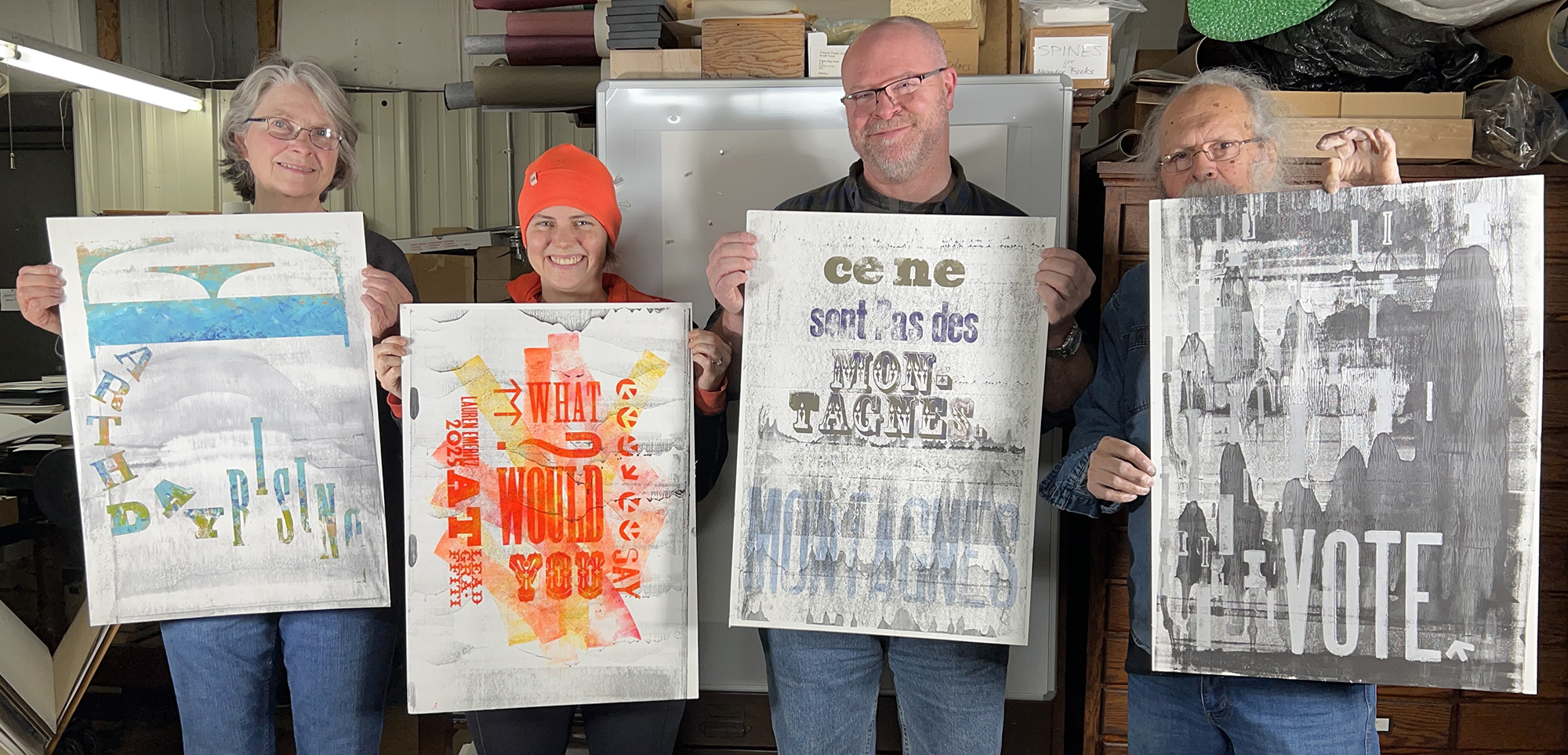
Lead Graffiti hosted a broadside printing using ink pulls as the basis. Chapter President Lauren Emeritz and Programming Committee member James Quigley joined Jill Cypher and Ray Nichols.

We are sold out of the 2026 calendars
For past events in the Chesapeake Chapter 2025, click here.
To see work from Chapter letterpress printers, click here
To see a few APHA Chesapeake calendars / ’24, ’23, ’22.
Val Lucas talk to 2025
American Typecasting Fellowship Conference
Printing Stewards board member @Val Lucas gave a presentation to the 2025 American Typecasting Fellowship Conference. I think you should be able to see the talk by clicking here.
An article about Raven Press at the University of Delaware was started by Ray Nichols, Jill Cypher, and Bill Deering.
Don Starr teaches typography at the George Mason Korea campus in SOUTH KOREA. He says he is headed to a museum this weekend and passed along this URL OMG ARCHITECURE, for sure.
Lead Graffiti had an exhibition with 200 letterpress & book projects at the Frederick Book Arts Center, Frederick, Maryland from February 28 through May 3, 2025

Lead Graffiti has a major two-month-long solo exhibition with 200 pieces of our letterpress work at the Frederick Book Arts Center in Frederick, MD, running from Saturday, March 1, through Saturday, May 3, which is Print Day. We will be at the FBAC for two days during the exhibition. First, there will be a talk on Saturday, April 5 (2 – 4 pm), surrounded by the exhibition, about our endeavors, our design and printing process, and hopefully, answers to many questions about the work from those in attendance.
They also did a talk about their work and led their H.N. Werkman workshops, which were fabulous fun.
You can link to both websites at Frederick Book Arts Center and Lead Graffiti.
UMD Libraries Announce Gift
of 150-Year-Old Printing Presses
The University of Maryland Libraries are excited to announce the acquisition of two 19th-century iron Washington hand presses donated to Special Collections and University Archives by Christopher and Patricia Manson of Rockville, MD and Ellie Denker of Potomac, MD. These gifts will be the foundation for a new letterpress printing studio on the ground floor of Hornbake Library, set to open in 2025.
It is always fun to find a U.S. Stamp (or foreign, for that matter) with a history of printing focus. Recently discovered this 1939 3¢ celebrating the 300th anniversary of printing in colonial America. The stamp, issued on September 25, 1939, pictures the Stephen Daye Press, the first printing press used in colonial America. The press was set up at Harvard College and printed the Freeman’s Oath in 1639.

The press shown on the stamp is similar to the common press the Chesapeake Chapter recently donated to the Library of Congress. Now, we need to take this nice block-of-4 and include it in a broadside that we can display in the room.

Casey Smith,
our Chapter Vice President,
has been named
Executive Director of the
Frederick Book Arts Center
in Frederick, Maryland.
Lead Graffiti Solo Exhibition
Newark Arts Alliance
Newark, DE
December 31, 2024 – January 17, 2025
Public reception
Friday, January 10, 6 – 8 pm
The letterpress studio of Lead Graffiti was voted Newark’s favorite artist of 2024 in a recent citizen poll by the Newark Post. That inspired the Newark Arts Alliance to dedicate its January exhibition to an overview of Lead Graffiti’s work over the past two decades and its dedication to “printing slowly & patiently via letterpress in Newark, Delaware.”
The solo exhibition, “Lead Graffiti: An Exhibition of Letterpress and Book Arts,” runs through January 17 at the Newark Arts Alliance Gallery in the Shoppes at Louviers on Paper Mill Road. A public reception will be held on January 10 from 6 to 8 p.m. The gallery is open to the public from noon to 4 p.m. daily and noon to 8 p.m. on Fridays.


Greetings, my thoughtful, creative, politically responsible friends!
Welcome to a riot of obsolescence!
The Impartial Observer is an artistic and literary venture — a quarterly journal — that flies in the face of just about all contemporary trends. Chesapeake Chapter member Greg Robison is the mastermind behind it all. You can get to the website by clicking here.
This simple website is the most technologically advanced element of this whole initiative. I use email, too, of course — I’m not a Luddite — and am always happy to speak to you on the electric telephone. But the Impartial Observer itself is otherwise an entirely hand-crafted, artisanal publication. It’s a physical object you can hold, printed slowly and patiently in limited editions from cast metal type using new equipment and tools 150 years ago. As an artist, I consider it a work of art on paper. You know: “paper,” a traditional, noble material made of natural fibers, not “pay per” as in “pay-per-view.” With reasonable care, such a work on paper will last for centuries without requiring (as everything digital in the cloud does) a never-ending consumption of hydrocarbons. Just as to produce it required the destruction of hardly any hydrocarbons either. Oh, and it’s distributed strictly by hand or through the post. You can’t see it online.
The Impartial Observer is a venture that bucks other contemporary trends, too. I’m not seeking an enormous number of subscribers; I’m producing it only for friends like you. (If I don’t know you, introduce yourself. You’ll probably fit in nicely.) I accept no advertising. The Impartial Observer is not the mouthpiece for any movement or organization’s newsletter.
Although this work flows from diverse streams of interest and activity in my life — as a visual artist, writer, Catholic, meditator, educator, and letterpress printer since childhood — I don’t intend it to be all about me. I’m inviting you, my friends, to help me write it and thereby form a loose community of reflection, creativity, and action. Specifically, I welcome from subscribers what I call “Paragraphs:” thoughtfully written texts of exactly 100 words (remember, the paper is composed by hand!), anchored in the first-person singular for authenticity, on one (or a combination) of the thematic interests we share, to wit:
-
cultivation of a rich inner life through reflection, meditation, prayer, or similar practices;
-
living creatively, intentionally, and compassionately this one precious life we share, and doing so with curiosity and good humor; and
-
engaging in or supporting responsible social action to promote a more just, peaceful, and inclusive world.
|
|


The Chesapeake Chapter of the American Printing History Association is now accepting applications for its Michael Denker Fellowships.
About the Fellowship

Established in the memory of longtime chapter contributor, wood type collector, letterpress printer, and friend Michael Denker, a year-long fellowship, as a one-time award, provides free membership in the national association and the Chesapeake Chapter, invitations to Chapter events such as studio tours, behind-the-scenes museum visits, workshops, and more, as well as discounted registration for the annual national APHA conference and a subscription to the semiannual journal “Printing History.” The fellowship also provides an opportunity to present a body of work or research at the annual Chapter symposium at the Library of Congress, Washington, DC.
About APHA
The American Printing History Association promotes the study of the history of printing and related arts and crafts, including calligraphy, typefounding, typography, papermaking, bookbinding, illustration, and publishing. The Chesapeake Chapter comprises printers, artists, curators, historians, and collectors in the DC-Baltimore-Virginia-Delaware area. For more information about APHA, visit the national website at printinghistory.org.
To Apply
Send a short statement expressing your interest in the history and practice of printing and related arts and what you hope to gain from joining the Chapter’s diverse community. The deadline to apply is November 15th. Send your statement (or any questions) to the Chapter Secretary (ChesapeakeAPHA@gmail.com) with the subject “Denker Fellowship Application.”
Applications will be notified in December.
Chesapeake Chapter Notes
Chesapeake Chapter Notes is emailed monthly to members and friends of the Chesapeake Chapter of the American Printing History Association. I want you to know that contributions are welcome and can be sent to the Chapter Secretary (ChesapeakeAPHA@gmail.com).
Just hiding this down at the bottom for a bit.
, Jill Cypher, Mike Denker (coming), Lauren Emeritz, Seth Gotlteib, Steve Heaver, Roland Hoover, Chris Manson, Carol Maurer
, Rebecca Johnson Melvin, Randy Newcomer, Stan Nelson, Greg Robison, Tatiana Shukhin, Casey Smit, Don Starr, Ray Nichols, James Quigley
Jill Cypher (coming)
Mike Denker (coming)
Lauren Emeritz
Seth Gotlteib
Steve Heaver
Roland Hoover
Chris Manson
Carol Maurer
Rebecca Johnson Melvin
Randy Newcomer
Stan Nelson
Ray Nichols
James Quigley
Greg Robison
Tatiana Shukhin
Casey Smit
Don Starr