
The Linotype and the Invention of Mass Media
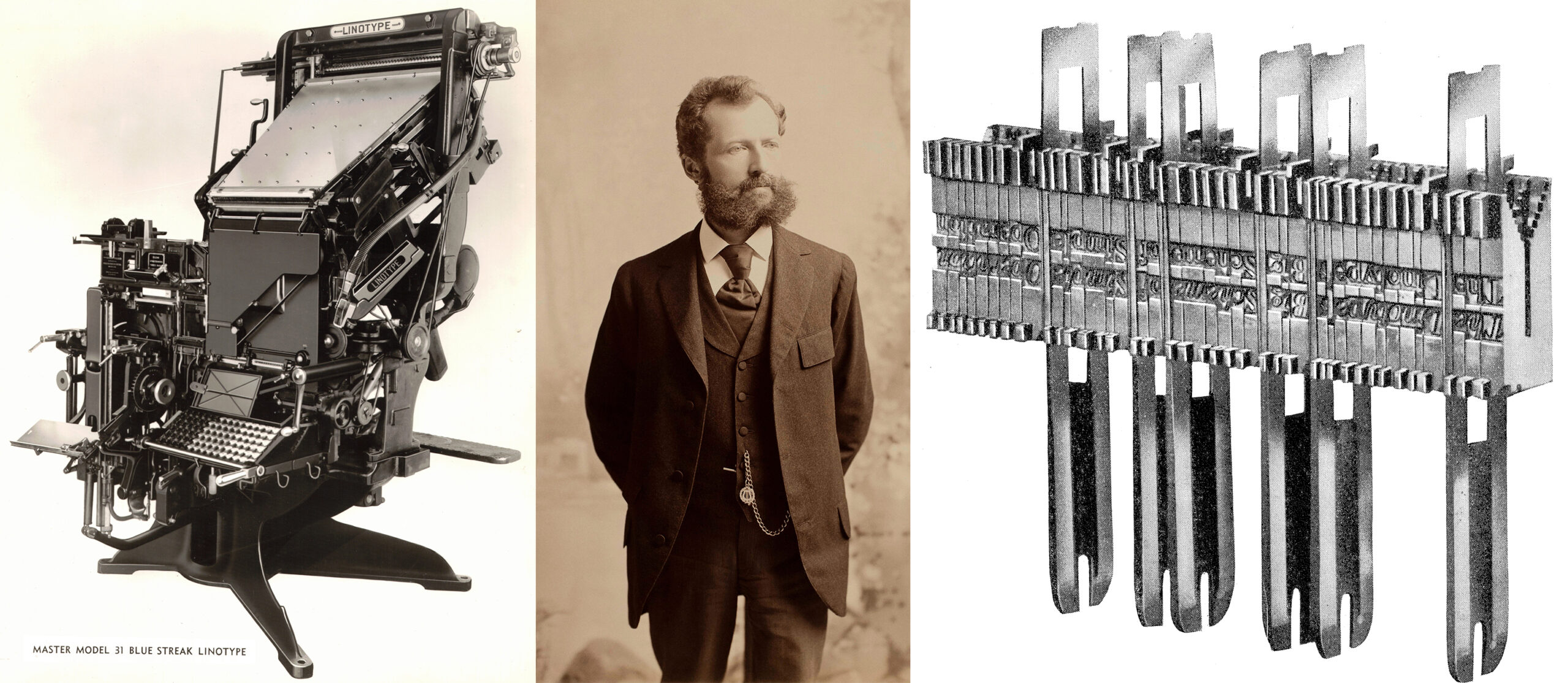
Model 31 Linotype, Ottmar Mergenthaler, Linotype matrices with spacebands.
 Lightning Round Presentation. After the steel press, stereotyping, steam-powered rotary presses, paper from wood pulp, and the telegraph, the publishing industry awaited one last machine that would open the floodgates to mass media: the typesetting machine.
“It is discreditable to the inventive genius of this country that the one great mechanical want of our time is still unsupplied,” said New York’s World in 1869. “We want the means of supplying the demand for reading matter. The inventive talent of the country produced the steamboat, the cotton-gin and the electric telegraph.” Why not a typesetting machine?
Three hundred attempts failed, including the one that sent investor Mark Twain into bankruptcy: the Paige Compositor. Seeing the future in the analog of the past, all these machines tried to replicate one or two of the various steps of composing type: founding the type, composing it, hyphenating and justifying it, redistributing it.
At last came the Linotype. Its inspiration was James O. Clephane, the best stenographer in Lincoln’s cabinet. He cared about recording events—thus, he tested the earliest Sholes typewriters, invested in the Graphophone and became a director of the company that would become Columbia Records, and had the idea for a typesetting machine.
After a few failures of his own, Clephane came to meet German watchmaker Ottmar Mergenthaler. Because neither was a printer, they saw the challenge differently. Eurekas are rare, for invention is more iteration than inspiration. But Mergenthaler came to his eurekas when he thought of creating hundreds of molds—matrices—for every character so they could be grouped into words: a singular mold shot through with lead. Thus the line o’ type.
The first working machine was installed in the ninth-story composing room of the New York Tribune in July 1886. Soon it would displace 100 compositors and their typecases. By 1893, 845 of the machines were operating in 113 US newspapers. In 1897, there were more than 3,000 in 741 newspapers. By 1911, 29,000 Linotypes had been manufactured in the US, UK, Canada, and Germany.
Mass media arrived with speed, savings, and scale. The machine could produce text four times faster than human typesetters, feeding presses that could now turn out 10,000 copies of sixteen-page papers in a half-hour. The productivity of each worker in printing increased 20, 30, even 100-fold, said a 1900 Congressional Industrial Commission. It is notable, by the way, that Congress studied the impact of these new, industrial technologies. (If only they were capable of doing likewise with AI.) Said the Bureau of Labor Statistics:
Speed, and more speed, is demanded first of all. The vast importance of modern events, their sudden and frequent occurrence, and the desire of the public for immediate knowledge of such transactions, together with competition and the aim of each newspaper to publish the events in advance of its contemporaries, have resulted in making speed the paramount issue. The shortest possible time between receipt of the news and its publication is an important sales factor. It is often not only a question of minutes, but of seconds. Newspaper publishers naturally try to keep their mechanical production at the lowest possible cost, but on the larger newspapers often sacrifice all for speed.
Rather than pocketing the dividends of efficiency, publishers invested in expansion. Before the mechanization and industrialization of printing, the average daily newspaper was four, perhaps eight, pages long with a circulation of no more than 4,000, given the limits of human muscle. A 1929 Bureau of Labor Statistics report cited one newspaper that grew from a dozen pages in 1996 to double that in 1916 and three times that in 1926.
The consumption of paper—whose cost fell from 24 cents a pound in the Civil War to two cents or less at the turn of the century, thanks to machine-made paper made in rolls from wood pulp—rose by 550 percent between 1880 and 1900.
The number of publications grew for a time. In the first decade of the last century, the number of newspapers increased by 26 percent, according to the BLS. But then came consolidation as capital ruled the industry: The number of publications fell by 11 percent in the next decade, then by 37 percent by 1925. At the same time, the average circulation of daily newspapers quadrupled. Readership consolidated.
Ownership also consolidated as the premier mass-media moguls—Pulitzer, Hearst, Munsey, Scripps—built chains, which controlled more than a third of circulation and eighty percent of industry value.
General-interest news publications rose by two thirds while the number of specialized religious and scientific publications fell. “Publications devoted to specialties slowly yielded ground to the large daily newspapers, which invaded every field of journalism,” said the 1900 Census.
This phenomenon the Census attributed to three factors: first, the development of “inexpensive and satisfactory” illustration with half-tone photographs to entice new audiences; second, the growth of the Sunday newspaper, “a department store of journalism”; and third, “the perfection of the composing machine.”
What fascinates me in this saga is that the new media moguls did not at first understand what their business model would be. The same had been true with movable type. In 1500, a half-century after Gutenberg, printers were bankrupt with warehouses filled with unsold editions of the ancients. What saved them was Martin Luther and his Flugschriften—flying texts.
New York Tribune publisher Whitelaw Reid was the consummate capitalist—and the villain of my tale. He snatched the paper out from under its founder Horace Greeley, forced Mergenthaler out of the company that bore his name, and used Mergenthaler’s Linotype to automate his scab composing room. Reid understood the need for capital to buy machinery and the value of equity to control it.
Yet in 1879—seven years before his Linotype was installed—Reid addressed editors, saying eight-page newspapers were “too big already and too crowded with news to admit any advertisements at all” for “newspapers already present many different topics of human interest as the average mind cares to concern itself with.”
Reid predicted the volume of advertising would decrease, for publishers could not afford more paper to print them and merchants could not afford to reach publishers’ larger audiences. “The daring idea has sometimes been advanced that the coming newspaper would publish no advertisements.” He was very wrong.
Reid also disdained the mass audience. He lectured Phi Beta Kappa graduates at Vassar that America “has never been a land of equality, and one man has never been as good as another, and never will be …. There is not a newspaper today in New York, faulty as they all are, that is not better than its audience.”
The invention of the business model that would sustain mass media came instead from a magazine publisher, Frank Munsey.
At the turn of the century, media’s genres still jockeyed for position. Book publishers published magazines. Magazine publishers published books, fearing that books stole readers. Newspaper publishers published magazines and much else in Sunday editions that covered every possible interest for only a nickel.
Munsey saw no way for his egocentrically named monthly, Munsey’s, to compete, selling at 25-35 cents as most magazines did. So in November 1893, he chose to sell his for a dime. And his circulation soared from 20,000 to 150,000, to 700,000. Clearly, he lost money on every copy sold. He made it up on advertising.
Content became the honey to draw readers, and it was their attention he sold to advertisers. Thus was born the attention economy that sustained mass media for a century and has infected the internet with clickbait.
Said Munsey:
Fifty years ago the manufacturer marketed his product through the jobber; the jobber in turn sold to the wholesaler, the wholesalers to the retailer, and the retailer to the consumer …. All this changed today, and the change has been brought about chiefly by talking to the people through what is known as the advertisement …. Talking to people; that’s the idea.
In 1894, Munsey’s carried 19 pages of ads; in June 1907, it boasted 121 pages. And with them, the aesthetics of media changed. Typefounders still produced fancy faces to draw attention, with illustration via engraving and electroplating and soon halftones — and with that great innovation in design: white space.
Here, too, was the birth of the brand: Quaker Oats, National Biscuit Company, Kodak, Gillette, Campbell’s, Welch’s.
Books, meanwhile, also sought a new, mass business model. Books had to seek their readers, as only 1,090 bookstores dotted America in 1859. By 1914, there were still only 3,501. Mark Twain’s books were sold via subscription publishing. Imagine the house-to-house sales agent sticking a foot in the door to sell not pots and pans or patent medicines but instead literacy, tempting the reader with sample pages and illustrations from Huckleberry Finn. In 1874, the New York Tribune estimated that 50,000 such agents were employed by subscription publishers.
Subscription sales freed Twain from the expectations of high culture and its critics. Twain sought to entertain “the mighty mass of the uncultivated …. I have never tried in even one single instance, to help cultivate the cultivated classes. I was not equipped for that, either by native gifts or training. And I never had any ambition in that direction, but always hunted for bigger game—the masses.”
This is what attracted Twain to invest his fortune and his wife’s in the Paige Compositor. And that is what doomed his own subscription publishing house after a few grand successes—Hucklebettery Finn and Ulysses Grant’s autobiography—and a series of duds. He had no money left to rescue his house.
Twain’s last books were published by Harper’s—and set on Linotypes.
Twain did benefit from the machine, as he became one of publishing’s early best-selling authors and celebrities.
In 1895, The Bookman began publishing the first lists of most popular titles in stores. Frank Luther Mott set the bar for “best-seller” at “one percent of the total population of the continental United States for the decade in which the book was published.” To meet that standard today, a book would need to sell more than 3 million copies. For comparison, NPD BookScan said that in 2022, of 45,571 titles released just by the top ten publishers, only 163 books or 0.36 percent sold more than 100,000 copies in a year.
The scale of mass media has, I believe, skewed our collective cultural sense of value and definition of big. No single book, magazine, newspaper, website, or so-called influencer speaks for the zeitgeist of all.
There are many other stories around the invention of the Linotype that I tell in my book, which I don’t have time for today.
The story of labor at a time of technological change is most compelling, for the International Typographical Union—having learned lessons from the fate of the Luddites and Captain Swing, but also that of pressmen faced with steam-powered machines—had the impressive foresight to embrace the Linotype on one condition: that they operate and control it. That worked well for three-quarters of a century until the ITU faced the next technological challenges: punched paper tape that could run a Linotype like the robot it resembled; cold type or photocomposition; and finally PostScript, which superseded all that Gutenberg and Mergenthaler had created.
I was fortunate to have worked atop the watershed between the material and digital ages of text. At the end of the book, in a typographical autobiography, I examine how various technologies, from the typewriter (whose history I also explore) to the computer to desktop publishing, affected the way I wrote and thus thought.
I was the creator of Entertainment Weekly magazine and thanks to my wife, Tammy Westmark, it was the first major magazine published entirely on Macintoshes, with PostScript. Spoiler alert: She provides the end of my history from Gutenberg through Mergenthaler when she declares to a digital publishing conference that on the Mac, “we are all typesetters.”
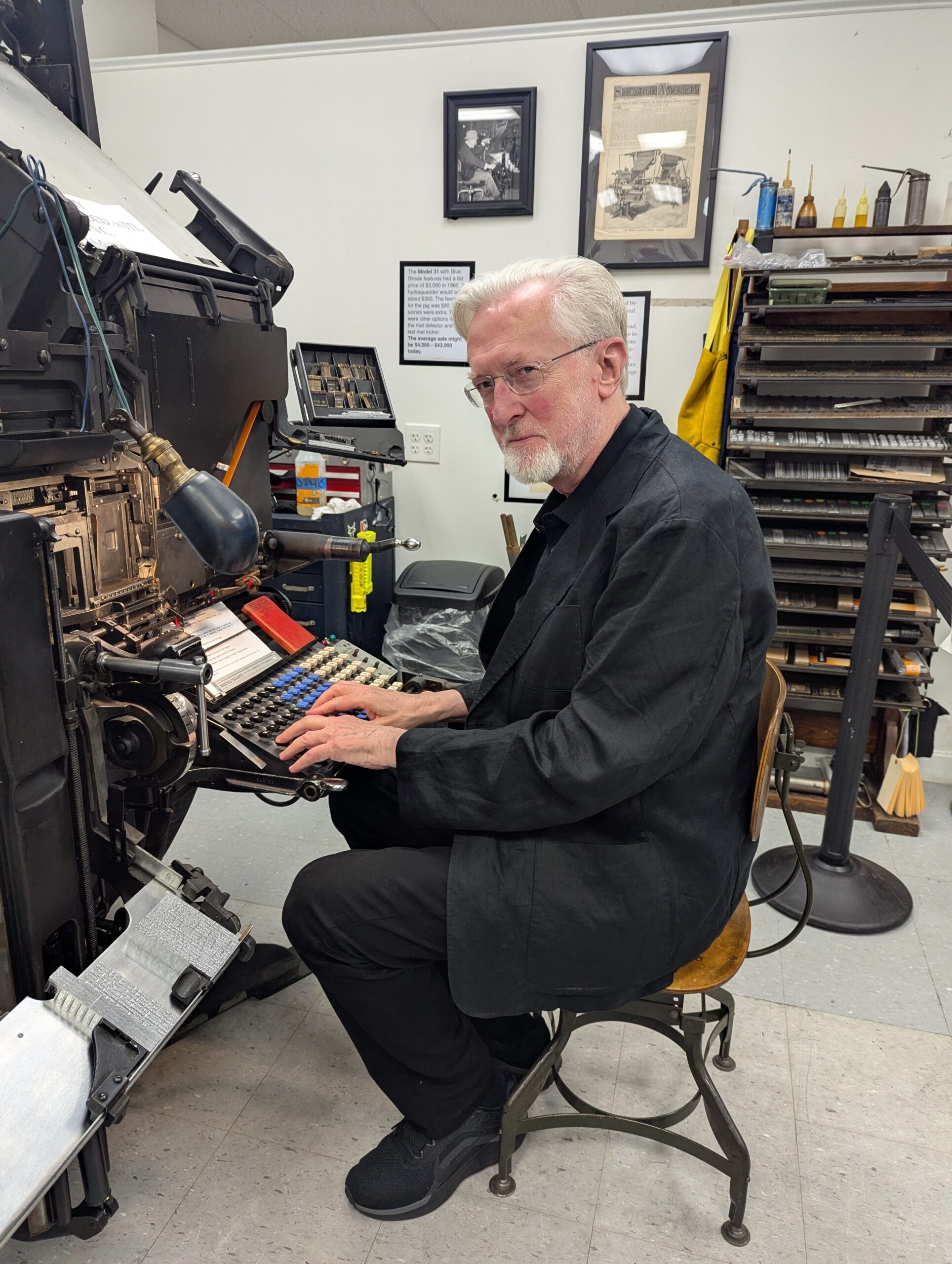
Jeff Jarvis at the Linotype keyboard.