Elizabeth Savage

Dr. Savage is 2014 recipient of the Mark Samuels Lasner fellowship, 2020 winner of the Schulman and Bullard Article Prize from the Association of Print Scholars, and internationally recognized as an expert in the field of early modern color printing history. Among the faculty at University of London (UK), and London Rare Book School, Savage was also named Honorary Fellow, Centre for the History of the Book, Oxford University. An advocate for academic collaboration and cross-disciplinary research, Savage’s work, as her nominators observed, lends “new insights into printing processes and practices across several types of media and genres” and “marries solid humanities methodologies with extensive knowledge of technical art history and heritage science.” Prolifically published, some of her most recent work includes a study that uses carbon-dating on late medieval and early modern woodblocks, and serving as co-editor for Printing Colour 1700–1830: Histories, Techniques, Functions, and Receptions (Oxford University Press, 2025).
Text of the presentation “Why Printing History Matters in 2026”
I am deeply grateful to the committee, Diane Dias De Fazio, Kara McLaughlin, and Sarah Allison. This prize often serves as a lifetime achievement award, and it is a shock to see my name listed among those of my research heroes. I especially recognize James Mosley and Michael Twyman, who passed away last year. I can’t say that this award is a dream of mine, because I hadn’t dared to dream it. I accept with profound gratitude, honor, and disbelief.
I was asked to give a statement of philosophy about printing history’s present and future. I recognize that not everybody in this room would identify as a historian. Some of us are printers. Some are librarians, curators, or conservators, across the GLAM sector, or galleries, libraries, archives, and museums. Some are collectors or dealers. Some are press builders, woodblock manufacturers and printing ink grinders. Printing history is many things. Our field is small. Our remit is huge: interdisciplinary, cross-sectorial, and international.
Today, I want to focus on the significance of history to the work of members of the American Printing History Association. Even those of us who don’t identify as historians recover and preserve artefacts, documentation, and skills to interpret the materials and techniques of printing. I understand printing history as the exploration of the physical production of information and knowledge itself—across all disciplines of the arts, humanities, and sciences that engage with content that was printed.
The State of The Field
Like all kinds of historical enquiry, printing history is incurring unprecedented risks. Ten years ago, former UK education secretary Michael Gove said, ‘people in this country have had enough of experts’.1 It now seems quaint. Today, about half of UK universities are in deficit2 Iand cutting staff or programmes.3 The national funding body pays PhD students below the poverty line.4 Over 15% of museums, 500, have closed in five years.5 This isn’t benign neglect. In the US, a ‘rapidly escalating campaign’6 of ‘assaulting’ higher education7 and GLAM8 aims to control knowledge sectors, fact, and truth itself, to reconstruct history.9 Artefacts, the knowledge they embody, experts to interpret them, and infrastructure to preserve them are at risk. In Trump’s term, history faces ‘civilizational erasure’.10
I’ve experienced this differently than most. Cathleen Baker and Rebecca Chung modelled a way to acknowledge women’s life events in knowledge production in their volume on Women in Printing and Publishing.11 Many of you don’t know this. Six years ago, covid left me disabled. This changed how I can do printing history. I had to relearn reading skills. My projects were interrupted, some for years. I cannot join you today because I am awaiting a wheelchair part. At one point, I thought my research career was over. I keenly feel the risks of rupturing the continuity of knowledge and practice. I keenly feel the need to engage with the past using whatever resources we can make available—including remotely.
All of this has changed not just how, but why I do printing history.
As printing historians, we’re guardians of a heritage of physically produced information. Preserving artefacts and skills requires protecting experts and institutions to extract information from them. All four are essential for the understanding of the human past—and the survival of our field. Doing printing history today means preserving the historical record and the knowledge it embodies, and using the resources available to us to defend fact, history, and knowledge against attack. How?
Our Artefacts: We Can Vigorously Protect Objects and The Skills to Use Them
One thing we can do is vigorously protect objects, tools, and the skills to use them to safeguard the objects and knowledge of our field.
In my work, this might involve re-classifying color frisket sheets from ‘waste’ to the earliest artefacts of printing presses in the west.12 I remain grateful to APHA for funding that project. Or re-attributing late medieval and early modern woodcuts to credit their forgotten color printers. Giving a name is an act of protection.
There are so many objects at risk. The risks are so real. Printing presses, equipment, and machines are outside many GLAM bodies’ acquisitions policies. These things measure by the tonne and square metre, not the sheet and shelf foot. Collections that have scope might not have space. If acquired, working things can be denatured as relics that cannot be used. This risks losing the skills needed to manufacture, employ, and repair them. And, when there’s a will, there isn’t always a way. The UK’s National Printing Heritage Trust has been trying to raise funds for a National Museum of Printing since 2016, when Gove wearied of experts.13 There are so many drops in this bucket.
Doing printing history today means using available resources to safeguard the tangible historical record, historical skills it supports, and infrastructure to use it, against ‘civilizational erasure’.
Our Skills: We Can Vigorously Defend Collaboration in Knowledge Production
A second thing we can do is vigorously defend collaboration in knowledge production to safeguard our community.
In this context, collaborative research can be a form of activism. Through my volumes, I hope to forge communities and bypass the silos of academic disciplines to engage with the historical record on its own terms. So far, they provide a platform for the work of over 80 experts (printers, librarians, curators, collectors, conservators—not just academics). They present not just methodologies for academic study, but for cataloguing, (re)making, and using these objects.
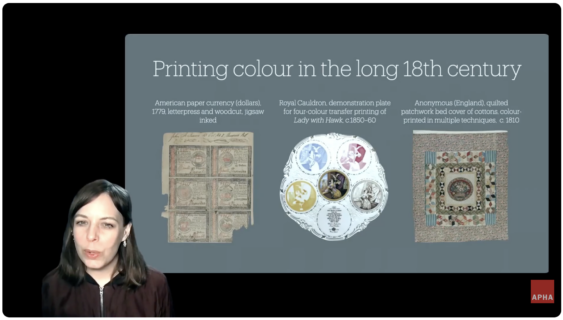
Last year, my co-editor Meg Grasselli and I pushed Printing Colour 1700–1830 to move past art museums and libraries.14 We wanted explore printing history in collections of, say, pottery, textiles, medicine, and currency. With nearly 30 contributors, we expanded the corpus of 18th-century color printing from a few fine artworks to millions of objects. This year, Printing Things, which I’m co-editing with Femke Speelberg, again with about 30 contributors, will discuss tens of thousands of heritage woodblocks and copper plates. Many are uncatalogued and considered un-catalogue-able. We aim to establish them as objects of research, independent from the content they printed. The numbers are big, but they’re still just drops in the bucket. Printing historians are a living library of generational wisdom. This work is possible only because of the wide range of printing historical skills that contributors have maintained.
Digitization progresses, but printing history’s between-the-gaps placement and collaborative knowledge practices mean that it can support fundamental research, across humanities and GLAM sectors, on an incredible scale. It can uncover ‘new’ categories of heritage materials that hide in plain sight. It can populate them. And it can interpret the vast amounts of information they offer. Doing printing history today means advocating for it, and creating platforms to formalize and promote its unique norms.
Our Experts: We Can Vigorously Defend Incoming Printing Historians
A third thing we can do is vigorously defend incoming printing historians to safeguard our field.
The landscape affects the lives and careers of all who engage with history. Printing history falls into gaps between academic fields and GLAM sectors, so it’s especially vulnerable to cuts. In my case, printing history has led me on a pinball career trajectory that will be familiar to many of you. It includes fixed-term and precarious roles. I’ve worked in GLAM collections, the trade, and departments of History of Art, English, and History. But squares on this bingo card are fading to the point that this game can no longer be played. I witness the chilling effects through the eyes of the PhD, postdoc, and at-risk and refugee scholars I support.
In my work, I try to recover silenced voices of the past where I can. One small example relates to recognizing woman’s collaborative roles in family projects. William Blake is credited with a famous episode of color printmaking—but I refer instead to ‘Catherine and William Blake’ to highlight his wife’s role in their collaborative work. This is a drop in a bucket. There’s so much to do, and so much drive to do it. But so little funding, and so much professional and personal risk. Today’s honor is greater because I stand in the shadow of Individual Laureates who give speech to those voices, including Kadin Henningsen on trans printers and Lisa Baskin on women printers. APHA models how a field can stand behind explorers of at-risk topics.
I also support printing historians at risk. My understanding of printing history has been greatly enriched through the NGO Science for Ukraine. It pairs at risk and refugee Ukrainian scholars with mentors who are familiar with other countries’ research norms. If you might be interested in joining me in supporting Ukrainian printing history and printing historians, please contact me or Science for Ukraine.15
Doing printing history today means safeguarding the future of the field, supporting those whose work is most vulnerable—whether those risks are professional, personal, or both. I’m delighted that the committee is not awarding me money today, but a certificate, because it means that APHA prioritizes printing historians who are incoming or without recourse to institutional funding. This is a concrete action to safeguard printing history’s experts.
Our Institutions: We Can Vigorously Defend Expertise Outside Academia
A fourth thing we can do is vigorously defend our institutions to safeguard printing history’s very special kind of expertise outside academia. Our institutions of knowledge can be elite museums or messy printshops.
From their origins as fields of enquiry around 1800, print and book history elevated collectors’ and scholars’ connoisseurship over collection professionals’ knowledge production and maker’s craft skills. Today, scoping in a collection can be dismissed as discovery even if it leads to cataloguing. Both might be belittled as precursors to the ‘real’ research of interpretation.
So, in a tidal wave of the heartbreaking new genre of ‘why we matter’, printing historians can be called on to justify our existence.16 This speech is one example. In the UK, in the age of the Research Excellence Framework, our descriptive, qualitative outputs can be discouraged. They don’t meet the REF’s idiosyncratic definition of longform, qualitative research as 4* and ‘world-leading’. Experiential knowledge gained at the press is even more suspect. This is slowly changing, but printing historians have long been making and knowing without recognition. Printing history recognizes that discovery, description, and cataloguing projects are research. They make contributions to scholarship in and of themselves. We might be used to this, but it is remarkable and it must be defended.
Doing printing history today might mean reconceiving of it as a vast reserve of case studies. They can help justify at-risk investments in history, collections, and research and making infrastructures. Each (re)discovery, (re)identification, and (re)interpretation can contribute to scholarship, or safeguard knowledge against erasure. Each engagement of object-based, cross-sector expertise—in making, collections, and academia, which might look like an afternoon workshop at a messy press with grad students—is a drop in the bucket. But if you do it with intentionality, and explain the significance of your actions, it can help communicate our work’s value to policymakers and hostile audiences.
Conclusions
I want to end with more thanks. Being a printing historian means navigating between the worlds of collections, printshops, and academic fields. I am indebted to those who have helped me do so. In particular, I thank Alex Franklin, Meg Grasselli, David McKitterick, Raphaële Mouren, and Linda Stiber Morenus. I thank the 200 members of the listserv community Blocks Plates Stones—which I moderate with Giles Bergel and hope you will join—for celebrating how printing history requires a collective effort from many perspectives. I thank Stacey Scott. I thank Lisa Dallavalle. I thank Magda Hunt Onatra, who is my ‘library legs’ through The Work Inclusion Project when I can’t physically access collections. Most of all, I thank Michelle.
I am grateful to those who nominated me. Every APHA event I have engaged with has been great fun. As an academic, that is the highest praise: none of us have to be here, but we all want to be here. This community is a bastion against current threats. This honor means all the more coming from you.
Now, I hope you’ll join me in applauding the APHA for its work to valorize many kinds of printing history expertise, create communities to safeguard the historical record of printing and the skills to interpret it, and honor our diverse predecessors at the press by using the tools available to us to protect truth and fact. Drops in the bucket add up. Printing history is precious and worth protecting.
Thank you, once again.
Afterword, January 27, 2026
This acceptance speech was finalised and recorded on December 15, 2025. The video is dated January 24, 2026, when it was played at APHA’s annual meeting. I realised as I was leaving that meeting that my speech already belonged to the past. So, I’d like to offer an Afterword. I’ll survey some changes to offer future readers a snapshot of what this rapidly shifting landscape looks like today. Then, I’ll propose a revised ending to the speech, one I would have put forward if I’d written it on the day it was delivered.
The State of Play in mid-December 2026
When I wrote this speech, Trump’s use of “civilizational erasure” was in the news. I want to emphasize for future readers that this chilling phrase, which foreign governments immediately condemned as “white supremacist ideology,”17 quickly disappeared in the madcap speed of the news cycle. However, the Trump administration’s mirror-image actions have continued apace to erase historical and cultural evidence in research and heritage collections that don’t conform to its ideals. At that point, some researchers, and research and heritage institutions, had been silenced from engaging with historical evidence that countered the Trump administration’s narrative, with only a few of those knowledge institutions facing a “extinction-level event,” so far.18
Perhaps more importantly, the Trump administration’s “Compact” for universities was long off radar.19 No universities had accepted this voluntary memo, and it was believed that the Trump administration had abandoned it. It had been out of the news for months. I’ll come back to this, so it’s important to clarify here that it offered a test cohort of universities membership in a scheme that would offer the choice between either restrictions on academic freedom20 with the apparent intent to transform all members and bodies of the university21 into propaganda generators on the one hand, or devastating funding cuts on the other.22 Member universities would pledge to police non-compliance, such as any activity considered to “belittle” “conservative ideas,”23 with violence (or “lawful force”) even preventatively.24 The wording suggests that non-compliance might become a federal crime; at least, the Department of Justice would have oversight over “adherence.”25 As for all other domains, this would have massive and immediate ramifications for printing history. That includes for all higher education-linked spaces of creative production, like printshops; sites of research, like collections of printed materials; and the people who work in, use, and study them.
All of that was current as of last month, around 15 December.
The State of Play in mid-January 2026
In the days before the speech was played in January, much changed. World leaders started frankly discussing the “complete collapse”26 of “international rules-based order,”27 and Amnesty International had reported that the rise of authoritarianism in the U.S. has reached an “emergency” stage,28 for example.
The State of Play on January 24, 2026
On 24 January, when I left the annual meeting, I learned that Alex Pretti had been killed a few hours earlier. His is often (incorrectly) discussed as the second killing of a U.S. citizen by U.S. Immigration and Customs Enforcement (ICE) in public view, after Renée Good on January 7, 2026. But their killings follow that of Keith Porter, a Black U.S. citizen, on December 31, 2025, as well as dozens of shootings—and dozens of deaths from shooting and other causes—of mainly non-white, non-U.S. citizens under ICE’s authority or custody.29 Their deaths have attracted much less attention than those of the two white U.S. citizens—even though some also were shot to death in public view, as was Silverio Villegas González on September 12, 2025, for example. But this is where we are right now: Good’s and Pretti’s deaths are widely considered to mark a turning point, and Vice President J. D. Vance’s response to public outcry included announcing that ICE agents are now “protected by absolute immunity.”30
A pattern is emerging. When the Trump administration makes statements about these deaths, its claims are incompatible with the evidence captured in bystander videos and use that mirror-image logic to blame the victims for their own deaths.31 These are very clearly situations in which both things cannot be true at once. A couple of weeks ago, such killings were unimaginable. As were such blatantly counterfactual, easily disproven official statements, even given the long acclimatization to both Trump administrations’ “alternative facts,” in the words of Kellyanne Conway, Trump’s former press secretary, a decade ago.32
Now, no fact is safe. Globally significant, unique, undigitized research materials face being “tossed away” despite international outcries.33 No higher education-affiliated research body, collection, or creative maker space, is safe. A more robust version of the Compact, currently known as “Compact 2.0,”34 is in development to “enforce” compliance, “regardless of whether schools sign on.”35 Empirical observation to establish fact is not safe. For institutions, dispassionately maintaining and documenting evidence brings risk of closure by financial starvation—or abandoning their mission. For individuals, at least in the context of ICE agents and at least for now, the same brings risk of life-changing injury and death. In terms of the demonization and silencing of empirical observation, you could say that these are all sides of the same trick coin. Today, as I was finalising this Afterword, an ICE agent summarised this interconnectedness in a threat to make an unarmed person to stop observing: “If you raise your voice, I’ll erase your voice.”36
A Revised Ending
In this context, I return to my question: why does the field of printing history matter in 2026? If I had written this speech on January 24, the date it was delivered, I would have ended it very differently:
Theorists discuss existential threats, or threats to existence, in broad terms. But they are easier to perceive in personal terms: threats to ourselves, our friends and family, and institutions we care about. Like everyone else, I can speak only from my own experience. I am the granddaughter of an “illegal alien” in the U.S., in the hateful term used by the Trump administration; I celebrate any way of leaving Nazi Germany as an unequivocal good. Then, when I was around the same age, I had to emigrate from the U.S. in order to access full civil rights, including the right to marry. Now, as an American, German, and British citizen, I am an immigrant no matter where I go. As a visibly disabled lesbian perma-immigrant, with this family background, I know that I’m unusually sensitive to risks and patterns that some might not perceive—and that I’m sensitive to the importance of protecting history in the limited ways that I can. But this time, a vast number of expert authorities, and everyday people, are pinpointing that we are at the same moment on the arc of a familiar plotline that recent, traumatized generations of my family, and of so many others, believed would never be repeated.
As a printing historian, a historian and practitioner of the communication of information in the broadest terms, I consider the erosion of the evidence-based approach that has defined knowledge since the Enlightenment as core to the Trump administration’s deeply interconnected projects to A) purge “woke” thought and B) target groups including immigrants, trans people, Black people, indigenous people, and other people of colour. Together, they form a project that can be positioned as “correcting” America’s past, present, and future. To reimagine America’s past, the program of historical revision involves suppressing and re-writing scholarly narratives; compromising the collections they are based on; destroying data and resources that document these stories; targeting experts who refuse to comply; and defunding knowledge institutions. To reimagine America’s present, the many fronts include ICE’s raids and detention centres. For America’s future, and the world’s, so much more is now at risk.
Protecting human life is paramount. Protecting history is paramount. These are things can be true at once. Printshops are, famously, sites for free thought and free speech. As printing historians, we can apply theoretical frameworks to our own spheres of activity and influence to understand how these points are connected and ensure we use our words and actions with intention. For example, as Hannah Arendt wrote, it’s essential to counter actions that have “exploded the limits of law”37 (for example, ICE’s record-breaking violations of court orders38 and the protocol-breaching purging of objects and resources with that “improper ideology” from GLAM collections). One strategy for doing so is upholding the “disinterested pursuit of truth [that] precedes all our theoretical and scientific traditions”39 (in our case, impartial research and collection management, such as APHA’s bolstering of the understanding of artefacts and practices linked to members of marginalized and at-risk communities). This can be done only in institutions of free thought (heritage and educational institutions, creative maker spaces), and with discussions and actions in “spaces of appearance”40 (public forums for speech and action; depending on content, this could include forums like that APHA meeting, or a workshop at the press).
In the announcement of this year’s awards, APHA reiterated its promise from 2020 to “strengthen education about, and support and promote printers and allied craft workers who are Black, Indigenous, and People of Color (BIPOC)”.41 It has used its most prestigious platform to celebrate the work of the Pyramid Atlantic Art Centre, which privileges inclusivity in printing practices, by awarding it this year’s Institutional Laureate. The current programme of workshops and exhibition of prints by Hadiya Williams that explore her identity and experiences as a Black woman in this world are so important.42 That APHA has redoubled its commitment to supporting spaces of appearance, and is taking actions such as varying its template to create a platform for this Afterword, models how a small scholarly society can serve as a modern version of what Arendt called a “refuge for truth”43 (a site for the disinterested pursuit of fact, in academia and cultural heritage institutions).
APHA has about 300 members, or roughly 0.00008746% of the US population. We are a drop in the bucket. But drops in the bucket add up. Thank you, once again.
Notes
- 1 Henry Mance, “Britain Has Had Enough of Experts, Says Gove,” Financial Times, June 3, 2016, https://www.ft.com/content/3be49734-29cb-11e6-83e4-abc22d5d108c.
- 2 Financial Sustainability of Higher Education Providers in England: 2024, Office for Students (OFS), published 16 May 2024, https://www.officeforstudents.org.uk/publications/financial-sustainability-of-higher-education-providers-in-england-2024/.
- 3 “Stop the Cuts: Fund Higher Education NOW!” University and College Union, July 17, 2025, https://www.ucu.org.uk/stopthecutscampaign.
- 4 As of December 2025, the PhD stipend from United Kingdom Research and Innovation’s (URKI) is £20,780. Assuming 37.5-hour weeks, the minimum national living wage is £24,784.5 and the real living wage is £26,227 UK Research and Innovation. “UKRI is Increasing PhD Stipends and Improving Student Support,” UKRI, January 25, 2025, https://www.ukri.org/news/ukri-is-increasing-phd-stipends-and-improving-student-support/; “National Minimum Wage and National Living Wage Rates,” Gov.uk, effective 2025, https://www.gov.uk/national-minimum-wage-rates; “What is the Living Wage as an Annual Salary?,” Living Wage Foundation, effective 2025, https://www.livingwage.org.uk/node/29657.
- 5 “Museum Closure in the UK 2000–2025,” Mapping Museums Lab, 2025, https://mapping-museums.bbk.ac.uk/museum-closure-in-the-uk-2000-2025/.
- 6 Michael C. Bender and Sheryl Gay Stolberg, “Trump Administration Freezes $1 Billion for Cornell and $790 Million for Northwestern, Officials Say,” New York Times, April 15, 2025,
- 7 Bender and Stolberg, “Trump Administration”; Michale C. Bender and Stephanie Saul, “Trump Administration Sends Harvard a List of Demands to Protect Federal Funds,” New York Times, April 3, 2025, https://www.nytimes.com/2025/04/03/us/politics/trump-harvard-funding-demands.html.
- 8 National Snapshot of United States Museums, American Alliance of Museums (AAM), published July-August 2025, https://www.aam-us.org/wp-content/uploads/2025/11/AAMSnapshotReport25.pdf; Hannah Weinberg, “Tracking The Trump Administration’s Attacks on Libraries: A Roundup of The Latest Executive Challenges and Efforts to Fight Back,” American Libraries, updated March 24, 2025, https://americanlibrariesmagazine.org/2025/03/19/tracking-the-trump-administrations-attacks-on-libraries.
- 9 Executive Office of the President, “Restoring Truth and Sanity to American History,” Federal Register 90, no. 65, April 3, 2025: 14563–14565, https://www.govinfo.gov/content/pkg/FR-2025-04-03/pdf/2025-05838.pdf.
- 10 Brandon Livesay, “Trump Administration Says Europe Faces ‘Civilisational Erasure’,” BBC News, December 5, 2025, https://www.bbc.co.uk/news/articles/c04vdengk3do.
- 11 Cathleen A. Baker and Rebecca M. Chung, eds, Making Impressions: Women in Printing and Publishing (Ann Arbor, MI: The Legacy Press, 2020).
- 12 Elizabeth Upper, “Red Frisket Sheets, c. 1490–1700: The Earliest Artefacts of Colour Printing in the West”, Papers of the Bibliographical Society of America 108, no. 4 (2014), 447–522; Elizabeth Savage, ‘New Evidence of Erhard Ratdolt’s Working Practices: The After-life of Two Red Frisket-sheets from the Missale Constantiense (ca 1505)’, Journal of the Printing Historical Society, New Series 22 (2015), 81–97.
- 13 Printing Historical Society, “The National Printing Heritage Committee,” 2025, https://www.printinghistoricalsociety.org.uk/nphc.
- 14 Margaret Morgan Savage and Elizabeth Savage, eds., Printing Colour 1700–1830: History, Techniques, Functions and Receptions (Proceedings of the British Academy, Oxford: Oxford University Press, 2024).
- 15 Those in the UK can register as potential mentors at Science for Ukraine UK, ‘Mentoring Scheme’, https://academics4ukraine.co.uk/uk-mentoring-scheme/.
- 16 Just from 2024, for example, they include Maria Balsahw, Gathering of Strangers: Why Museums Matter (London: Tate Publishing, 2024); Claudia Lux, Libraries on the Agenda: Lobbying and Advocating for Library and Information Professionals (Berlin, Boston: De Gruyter Saur, 2024), https://www.degruyterbrill.com/document/doi/10.1515/9783110796087/html?srsltid=AfmBOoqamDQhk2dsF3AwWyQzZ7mXxr4pTqgwk0nE-fp4agUgF7pIPNz2; Pauline Mattsson, Eugenia Perez Vico, and Linus Salö, eds., Making Universities Matter: Collaboration, Engagement, Impact (Cham: Springer, 2024), https://link.springer.com/book/10.1007/978-3-031-48799-6; Daniel H. Weiss, Why the Museum Matters (New Haven, Yale University Press, 2024); Maria Balshaw, Gathering of Strangers: Why Museums Matter (London, Tate Publishing, 2024).
- 17 Eleni Courea, “US Engaging in ‘Extreme Rightwing Tropes’ Reminiscent of 1930s, British MPs Warn,” The Guardian, December 11, 2026, https://www.theguardian.com/uk-news/2025/dec/11/us-extreme-rightwing-tropes-1930s-british-mps-donald-trump-keir-starmer.
- 18 The Planetary Society, “A Potential Extinction-level Event? Discussing the Reported 50% Cut Coming for NASA’s Science Mission Directorate,” The Planetary Society, March 13, 2025, https://www.planetary.org/articles/nasa-science-cuts-discussion.
- 19 “Compact for Academic Excellence in Higher Education,” October 1, 2025, https://www.washingtonexaminer.com/wp-content/uploads/2025/10/Compact-for-Academic-Excellence-in-Higher-Education-10.1.pdf.
- 20 “[S]ignatories … shall recognise that academic freedom is not absolute.” “Compact,” p. 4.
- 21 Signatories would ensure compliance “with equal force to all of the university’s academic units, including all colleges, faculties, schools, departments, programs, centers, and institutes” as well as enact “disciplinary standards that apply equally to all students, faculty, and staff … in a manner consistent with institutional policies and applicable law” (which could be understood to include “lawful force,” per note 23 below). “Compact,” pp. 4, 5.
- 22 “[A]ll monies advanced by the U.S. government during the year of any violation shall be returned to the U.S. government. Finally, any private contributions to the university during the year(s) in which such violation occurred shall be returned to the grantor upon the request of the grantor.” “Compact,” p. 9.
- 23 “Compact,” p. 2.
- 24 “Signatories commit to using lawful force if necessary to prevent these violations.” “Compact,” p. 9.
- 25 “Adherence to this agreement shall be subject to review by the Department of Justice.” “Compact,” p. 9.
- 26 Gordon Brown, “As Trump Menaces Greenland, This Much is Clear: The Free World Needs a New Plan – and Inspired Leadership,” The Guardian, January 20, 2026, https://www.theguardian.com/commentisfree/2026/jan/20/donald-trump-greenland-world-plan-leadership.
- 27 “Davos 2026: Special Address by Mark Carney, Prime Minister of Canada,” World Economic Forum, January 20, 2026, https://www.weforum.org/stories/2026/01/davos-2026-special-address-by-mark-carney-prime-minister-of-canada/.
- 28 Amnesty International, “Ringing the Alarm Bells: Rising Authoritarian Practices and Erosion of Human Rights in the United States,” January 20, 2026, https://www.amnestyusa.org/reports/ringing-the-alarm-bells-rising-authoritarian-practices-and-erosion-of-human-rights-in-the-united-states/.
- 29 “Democrats Demand Documents from Kristi Noem After Record 53 Deaths in ICE & CBP Custody on Her Watch,” Congressman James Walkinshaw 11th District of Virginia, January 22, 2026, https://walkinshaw.house.gov/news/documentsingle.aspx?DocumentID=273. Those are deaths reported by ICE. As of January 27, 2026, another tally counts 27 shootings by agents of ICE and United States Customs and Border Protection (CBP), resulting in 8 deaths, of non-US citizens, just in the last year; “List of Shootings by U.S. Immigration Agents in the Second Trump Administration,” https://en.wikipedia.org/wiki/List_of_shootings_by_U.S._immigration_agents_in_the_second_Trump_administration.
- 30 J. D. Vance, White House Briefing, January 8, 2026, https://newsroom.ap.org/editorial-photos-videos/detail?itemid=5109e1f2c2504fc5b3249196cc6ba014&mediatype=video.
- 31 Holly Patrick, “White House Refuses to Say if Stephen Miller Will Apologize for Calling Alex Pretti ‘An Assassin’,” Independent, January 26, 2026, https://uk.news.yahoo.com/white-house-refuses-stephen-miller-201359543.html.
- 32 “Kellyanne Conway: Press Secretary Sean Spicer Gave ‘Alternative Facts’,” Meet the Press, NBC News, posted January 22, 2017, 3:35:00, https://www.youtube.com/watch?v=VSrEEDQgFc8.
- 33 Eric Niiler, “NASA’s Largest Library is Closing Amid Staff and Lab Cuts,” New York Times, December 31, 2025, https://www.nytimes.com/2025/12/31/climate/nasa-goddard-library-closing.html.
- 34 For the working name, see Michael T. Nietzel, “Another Version of Trump’s Higher Ed Compact Reportedly in the Works,” Forbes, January 22, 2026, https://www.forbes.com/sites/michaeltnietzel/2026/01/22/another-version-of-trumps-higher-ed-compact-reportedly-in-the-works/.
- 35 Michael C. Bender, Alan Blinder, and Michael S. Schmidt, “Investigations and a Billion-Dollar ‘Shakedown’: How Trump Targeted Higher Education,” New York Times, 21 January 2026, https://www.nytimes.com/2026/01/21/us/politics/trump-higher-education-2025.html.
- 36 Ellie Quinlan Houghtaling, “‘I Erase Your Voice’: ICE Agents Threaten People After Alex Pretti”, The New Republic, January 27, 2026, https://www.yahoo.com/news/articles/erase-voice-ice-agents-threaten-202108187.html.
- 37 The phrase originates in the letter Hannah Arendt to Karl Jaspers, August 17, 1946; see Hannah Arendt/Karl Jaspers Correspondence, 1926–1969; edited by Lotte Kohler and Hans Saner, translated by Robert and Rita Kimber (New York; Harcourt Brace Jovanovich, 1992), p. 54.
- 38 Minnesota District Judge Patrick J. Schlitz wrote, “ICE has likely violated more court orders in January 2026 than some federal agencies have violated in their entire existence”. Case no. 26‐CV‐0107 (PJS/DLM): Juan T.R. v. Noem, Department of Homeland Security, Lyons, Easterwood, January 28, 2026, pp. 2–3, https://storage.courtlistener.com/recap/gov.uscourts.mnd.230171/gov.uscourts.mnd.230171.10.0_2.pdf.
- 39 Hannah Arendt, “Truth and Politics”, New Yorker, February 25, 1967, p. 86.
- 40 Hannah Arendt, The Human Condition (Chicago: University of Chicago Press, 1958), p. 198–199.
- 41 “APHA Awards 2026,” American Printing History Association, December 8, 2026, https://printinghistory.org/apha-awards-2026.
- 42 “Offline: Tracing the Source: Works by Hadiya Williams,” curated by Anika Hobbs, Pyramid Atlantic Art Centre, January 23–March 3, 2026, https://pyramidatlanticartcenter.org/the-gallery/current-exhibition.
- 43 Arendt, “Truth and Politics”, p. 84.