Paine, Penn, and the Press
 Thank you for the invitation to participate in this conference. This anniversary year of 2026 has given us soccer matches and some silliness. But it’s also been an opportunity to look, or look again, at some of the most significant documents in the Revolution and at some of the intellectual dogmas around them. We’ve all been taught about “the printing press and the American Revolution”—but as James Green showed us in his “The Radical Printers of Revolutionary Philadelphia” and in his exhibit at the Library Company, we still have much to learn when we analyze what printers were doing, where they were doing it, how, and why.
My remarks are meant to be part of the conversation begun by Jim yesterday [October 2], around the “radical printers” of Pennsylvania’s Revolution.1 In addition to Jim, here are some of the other colleagues I have learned from. Parts of this project derive from a 2025 exhibit here in the Kislak Center entitled “Revolution at Penn?” which examined the role of this institution during the revolutionary era.2 I co-curated that exhibit with J.M. (Jim) Duffin, Assistant University Archivist here at Penn and the foremost expert on the land and property records of early Philadelphia. You’ll hear a bit about Jim’s research here. I’ve also learned a great deal from Jessica Peterson and her remarkable Declaration project, which has literally taken us into the work processes, of hand and head, that structured the early modern printing shop.3 Christopher Hunter, a Penn PhD in English, did important research on the newspaper debate I’ll be introducing to you. And, finally, my thanks to Lynne Farrington, with whom I co-curated another exhibition, recently, on the French and Haitian Revolutions and their impact in Philadelphia.4
I’d like to frame my remarks around three themes that James Green introduced yesterday:
-
Print and proximity
-
The politics, and pragmatics, of format
-
Liberty and a free press?
Print and Proximity
One of the stories we tell and retell about printing and publishing during the American Revolution centers around that most iconic of pamphlets, Thomas Paine’s Common Sense, issued on January 9, 1776, and advertised prominently in newspapers like the Pennsylvania Gazette. The “standard narrative” of the publication of Common Sense was perhaps best expressed by Benjamin Rush, who was in 1776 a close ally of Paine. Rush’s account raises several points of interest in relation to Jim’s arguments.
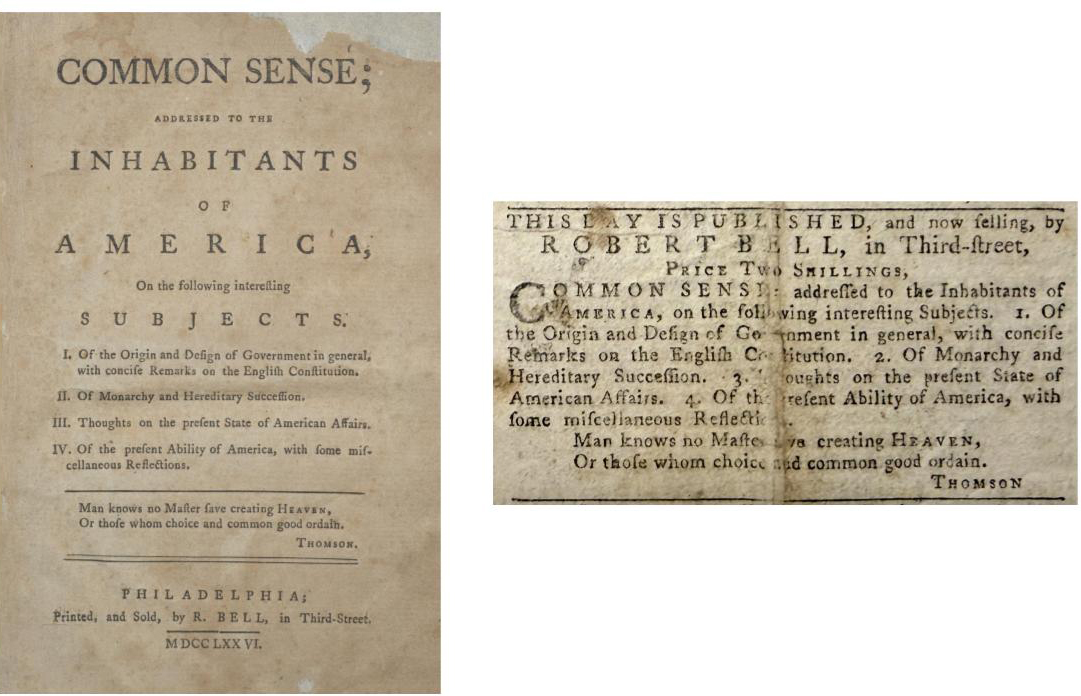
First printing of Common Sense and an advertisement for it in the Pennsylvania Gazette, January 10, 1776. (Kislak Center)
In an 1809 letter, Rush claims that he was the one who, frustrated with the “ordinary short and cold addresses of newspaper publications,” went to Paine and gave him the idea of publishing a work arguing for separation from Britain. In his Autobiography, also prepared decades later, Rush says he had thought of writing a pamphlet in favor of independence but was hesitant about publishing it. “I suggested to [Thomas Paine] that he had nothing to fear from the popular odium to which such a publication might expose him, for he could live anywhere, but that my profession and connections, which tied me to Philadelphia, where a great majority of the citizens and some of my friends were hostile to a separation of our country from Great Britain, forbade me to come forward as a pioneer in that important controversy.”5
Paine worked quickly; Rush says, “He read the sheets to me at my house as he composed them.” Benjamin Franklin, Samuel Adams, and David Rittenhouse all read the draft and made no changes.6 Rush also makes this note: “A title only was wanted for this pamphlet before it was committed to the press. Mr. Paine proposed to call it ‘Plain Truth.’ I objected to it and suggested the title of ‘Common Sense.’” Plain Truth would become the name of another pamphlet to which I will turn shortly.
Rush also found Paine his printer. This was Robert Bell, whom Rush calls “a thoughtless [!] and fearless Whig, and an open friend to independence.” In the 1809 letter, he tells it like this: “At that time there was a certain Robert Bell, an intelligent Scotch bookseller and printer in Philadelphia, whom I knew to be as high-toned as Mr. Paine upon the subject of American independence. I mentioned the pamphlet to him, and he at once consented to run the risk of publishing it. The author and the printer were immediately brought together, and Common Sense burst from the press of the latter in a few days with an effect which has rarely been produced by types and paper in any age or country.”
Although we may well want to read Rush’s reminiscences with some skepticism, I think they give us a number of important contextual details. Here, of course, is that famous narrative of how Paine’s pamphlet swept the field, going through 15 Philadelphia editions, and numerous printings outside of the city and in Great Britain. That’s actually not just a tall tale: as Jim makes clear, we need to take those dramatic figures as possible, even likely.
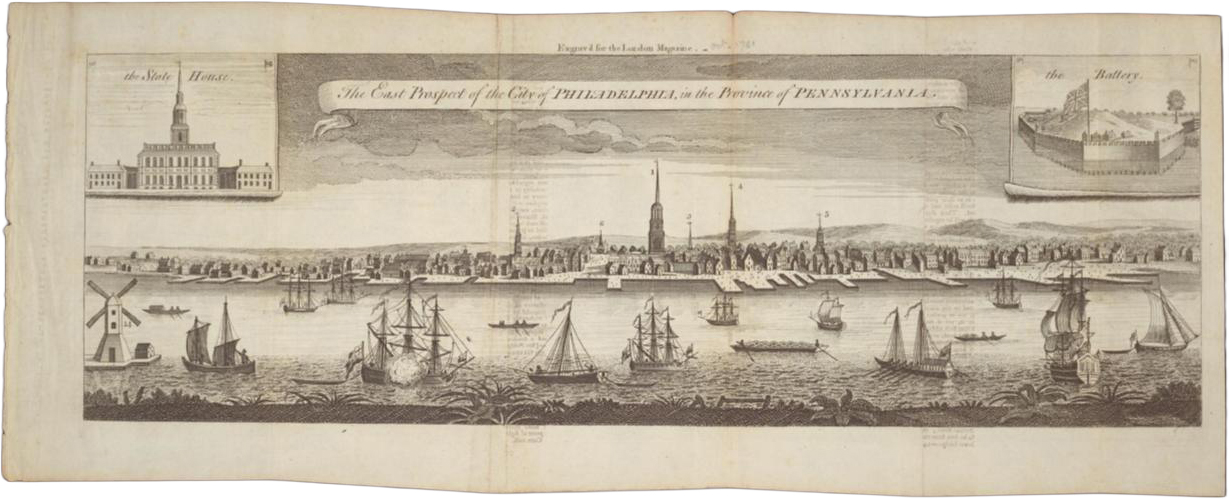
The East Prospect of the City of Philadelphia, in the Province of Pennsylvania / engrav’d for the London magazine. Engraving. [London: Richard Baldwin, [1761]. (Kislak Center)
I think that this is also a story of printing, politics, and proximity. We heard yesterday from Jim about “printers’ row” on Market Street between Front and Second Streets, where several of the radical printers were situated. Thanks to the pioneering map work of another Jim, my colleague Jim Duffin, we can explore this geography in more detail. Jim and Nancy Hagedorn’s digital project traces all known owners of properties in colonial Philadelphia, linked to the City’s 1775 Constable Returns to show where people were living. What may be surprising to modern viewers is the densely occupied urban space around today’s familiar historic sites.7
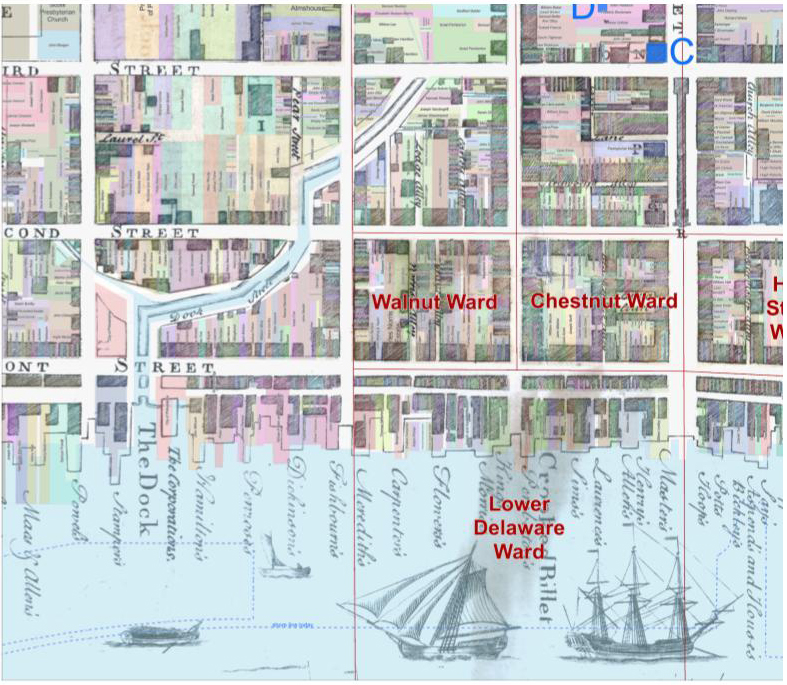
J. M. Duffin and Nancy L. Hagedorn. Map of Philadelphia streets, land parcels, and residents, 1775 [detail]. Digital project, 2025. Base map: Plan of the Improved Part of the City, engraved map by Matthew Clarkson and Mary Biddle, after Nicolas Scull, 1762.
When Paine arrived, nearly unknown, in Philadelphia late in 1774, he rented a dwelling at Front and Market Streets, across from London Coffee House, owned by William and Thomas Bradford in the heart of the busy city. He roomed next door to printer Robert Aitken and wrote articles for Aitken’s Pennsylvania Magazine in 1775.8 John Dunlap’s shop was up the block. Hall and Sellers were nearby. Robert Bell’s shop was not far, on 3d Street below Walnut Street.
And in this little neighborhood were the freethinking artisans, laborers, teachers, doctors, and artists that Paine connected with. This group was labeled by historian Eric Foner the “Philadelphia radicals”: Timothy Matlack, a brewer; Christopher Marshall, a pharmacist; Thomas Young, a doctor; Owen Biddle, a clockmaker; and Charles Wilson Peale, the portraitist.9
Moving just beyond Printers Row, I want to point out another important site: the College of Philadelphia, later the University of Pennsylvania, which sat in the midst of this compact city, at 4th and Arch Streets. This undated pencil sketch by Pierre Eugène Du Simitière, the revolutionary archivist at the heart of Jim Green’s Library Company exhibition, is the only known eighteenth-century image of the original buildings occupied by the university. The “New Building” (on the left) was Philadelphia’s largest public building in the period.10
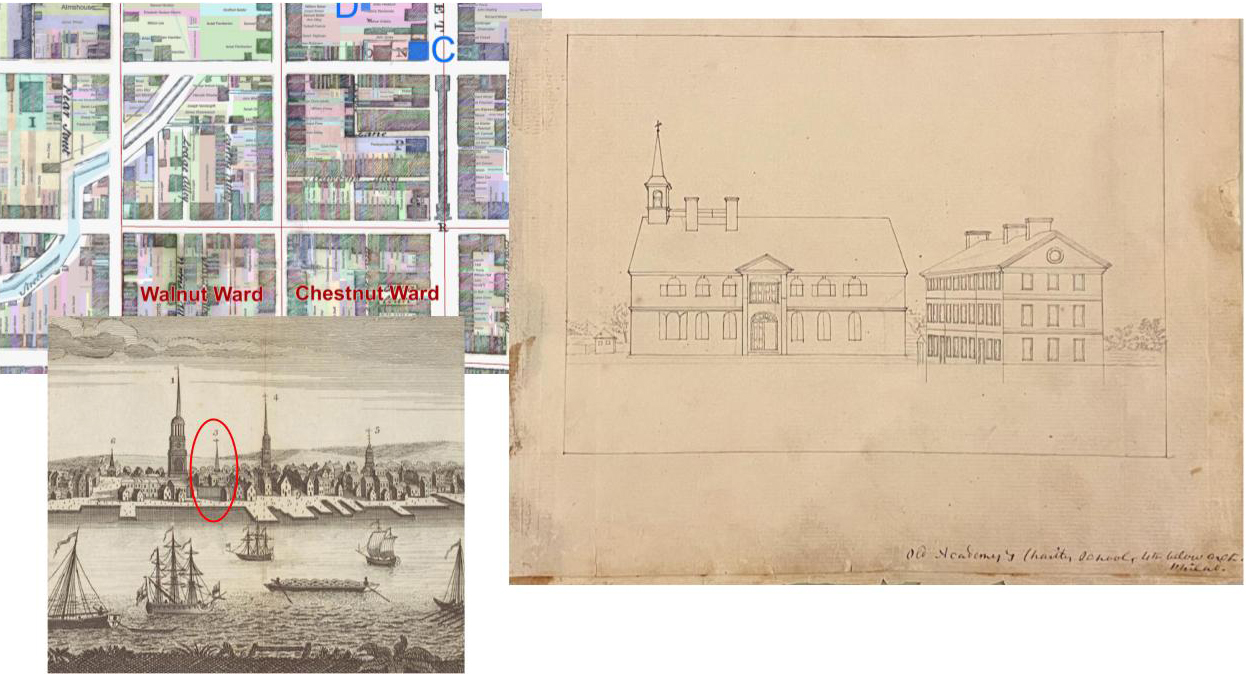
Pierre Eugène Du Simitière, ca. 1736-1784 “Old Academy & Charity School, 4th below Arch. Philad.” Drawing, pencil on paper, n.d. [before 1778?] (Library Company of Philadelphia, Pierre Eugène du Simitière collection)
Several individuals in the Common Sense story were connected with the College include:
-
Rush, who was a doctor and Professor in the Medical School
-
James Cannon, a Mathematics Professor in the College and crucial radical writer (more later on him)
-
David Rittenhouse, clockmaker and astronomer, who constructed the monumental Orrery for the College in the 1770s (behind me), and was later professor and trustee of the University
-
And Benjamin Franklin, who by this point was less connected with the school but was of course a figure connected to everyone.
-
Jim Duffin has also put together a chart—you are the first to see it—of the bookworkers in the city as of 1775. It’s an impressive list: we can see printers, booksellers, and bookbinders. And we know they all lived and worked near one another.
My point is that the story of Common Sense and of the radical printers is one of dense interconnection. Friends and enemies lived side by side. Christopher Marshall kept a detailed diary that covers these months: he writes of rushing from his house to the London Coffee shop for news, and to the College to meet with his fellow committee men. The printing shops were, surely, also these kinds of “third spaces,” where ideas were being argued over even as they took on material form in print. We like to talk and theorize about the “public sphere” created by print, in Habermas’s famous phrase. Here, that “print public sphere” was highly local, and it was one in which conversation and face-to-face communication would dominate and shape debate, reception, and even the entire independence movement.
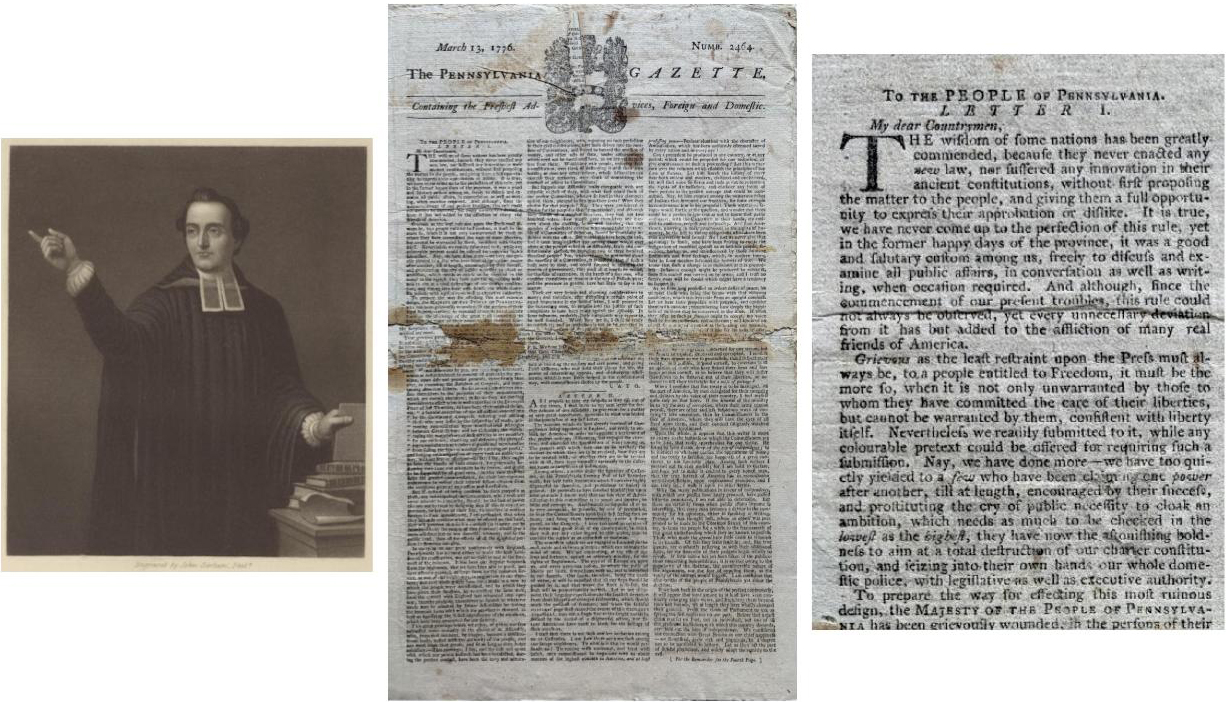
John Sartain, engraver (after painting by Benjamin West), William Smith. D.D., engraving, frontispiece to Horace Wemyss Smith, Life and Correspondence of the Rev. William Smith . . . (Philadelphia: Ferguson Bros. & Co., 1880) (Kislak Center). The Pennsylvania Gazette, March 13, 1776, p. 1 and detail. (Kislak Center)
The Politics and Pragmatics of Format
Jim contends that Philadelphia’s newspapers and their printer-editors were at the vanguard of revolutionary sentiment and revolutionary actions. That may not seem to be that much of a revolutionary claim. Historians who have attempted to follow the complex ins and outs of Philadelphia’s revolutionary years have, of course, drawn much of their evidence from newspapers, along with other print evidence like broadsides. But Jim is suggesting something larger, I think: that we might want to rethink a phenomenon I call the “Bailyn effect.” Bernard Bailyn’s The Ideological Origins of the American Revolution, a text first published in 1967, dives deeply into the enormous pamphlet literature issued in the 1760s and 1770s, taking seriously the various argumentative strategies of their writers and locating in them the sometimes surprising “ideological origins” that would, he argued, make a revolution thinkable.11 Pamphlets, we learned from Bailyn, were the debate in the Revolutionary moment: and where or when there were no pamphlets, or few of them, then there must have been little or no debate.12
Historians have always acknowledged the centrality of newspapers to the American Revolution. And recently, important work by Joseph Adelman, Emily Sneff, and others has added to that of previous scholars.13 Still, it feels as if the history of pamphlet debates, and the history of printers and their newspapers, ride on separate train tracks. If we assume that all or nearly all print political debate took place in pamphlet form, we will overlook how the debates might have taken shape in the newspapers.
Here again is Benjamin Rush, writing of the results of Common Sense’s publication:
Its effects were sudden and extensive upon the American mind. It was read by public men, repeated in clubs, spouted in Schools, and in one instance, delivered from the pulpit instead of a sermon by a clergyman in Connecticut. Several pamphlets were written against it, but they fell dead from the press. The controversy about independence was carried into the newspapers, in which I bore a busy part.14
Rush does claim that some pamphlets were printed to refute Common Sense, and it’s a point to which I’ll return, but he also says: “The controversy about independence was carried into the newspapers, in which I bore a busy part.” And it turns out that Paine’s arguments were contested, hotly, but in Philadelphia’s newspapers instead of in the pamphlet press. As Jim said last night, the rush of events may have made newspapers, instead of pamphlets, the best vehicle for political debate.
From early March through mid-May 1776, Philadelphia’s newspapers printed a long series of articles by Paine’s enemies, his allies, and Paine himself. All of the writers used pseudonyms. Paine himself entered the newspaper debates as “Forester.” The two main voices in the argument, besides Paine, were Penn leaders, so this might have felt to some like a faculty meeting gone out of control. One, James Cannon, was a Scot like Benjamin Rush and a militia leader.15 We know little about him except that he would play a key part in the drafting of the Pennsylvania Constitution later that year. He wrote under the pseudonym “Cassandra.”
The other, and main antagonist of Paine, appeared as “Cato.” This was Provost William Smith. Smith, the leader of the College, Academy, and Charitable Schools of Philadelphia—the institution that would be reinvented during and after the Revolution as the University of Pennsylvania—was no stranger to politics or to political controversy. From his arrival in the city in the 1750s, he sought to link the school closely to the Penn family, the “Proprietors” who controlled many aspects of the colony’s political life. He made an enemy of Benjamin Franklin, originally a supporter, with these moves. Most controversially, Smith, an Episcopal minister who preached frequently at Christ Church, worked to ensure an Anglican majority on the (rhetorically) non-denominational school’s Board of Trustees, alienating many others. His College was seen by many, including some of its own teachers, as an elite, Anglocentric institution.
Despite these conflicts, Smith had been a leader of some of the Philadelphia resistance movements of the 1770s. In May 1774, Smith met Paul Revere and worked alongside Philadelphia’s emerging radical leaders to form a “Committee of Correspondence” in support of resistance to the British “Intolerable” Acts closing the port of Boston.16 He gave a number of widely publicized public sermons in 1775 and 1776, defending the military and the work of the Continental Congress. However, after the publication of Common Sense, Smith seems to have taken on a more cautious position, advocating for continued negotiations and stressing the deep ties between the British and their colonial subjects. And, as Cato, he used the newspapers rather than the pulpit as his platform.
In 2017, Christopher Hunter (a Penn PhD who worked with Jim) prepared one of the only studies of these newspaper articles. He included a very useful chart that shows us the amazing way in which these articles were reprinted across the newspapers of Philadelphia.17 The debates went far beyond the words of Common Sense to take on all aspects of colonial politics, such as the possibilities of true “equality,” the privileges of elites, and the nature of a future government.18 They are also deeply personal, even vituperative. It feels like a small world in which personal arguments cast in only thinly veiled rhetorical style have made it onto the page. (At one point, Smith, as Cato, plays on Hamlet’s soliloquy—an extended rhetorical joke.)
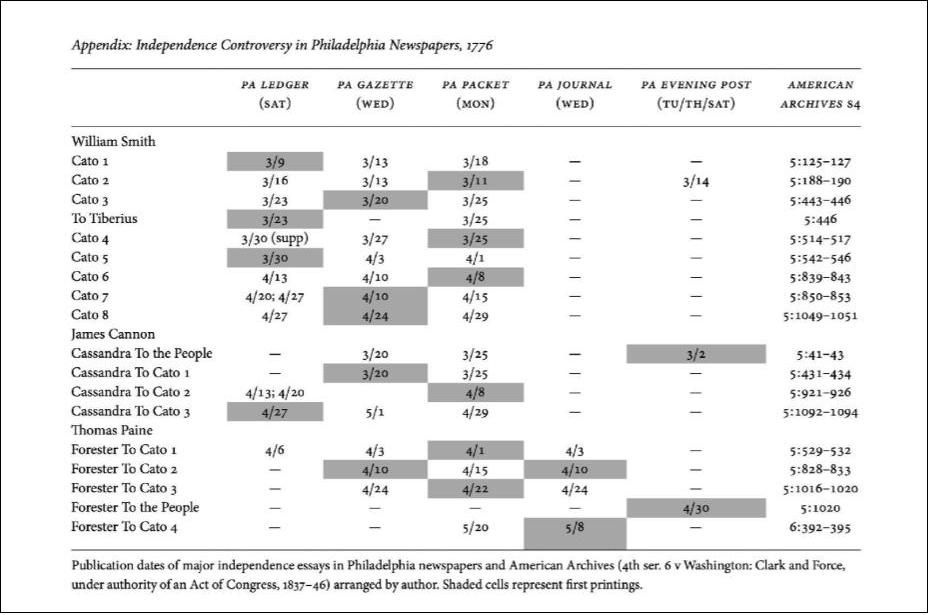
Chart from Christopher A. Hunter, “William Smith’s Catonian Loyalism, Race, and the Politics of Language.” Early American Literature 52, no. 3 (2017): 531–58.
But since we are thinking about printing here, let me offer a few observations on what I can see when looking at these papers (and I’ve spent most of my time looking at Hall and Sellers’s Pennsylvania Gazette, because Penn has a number of these copies).
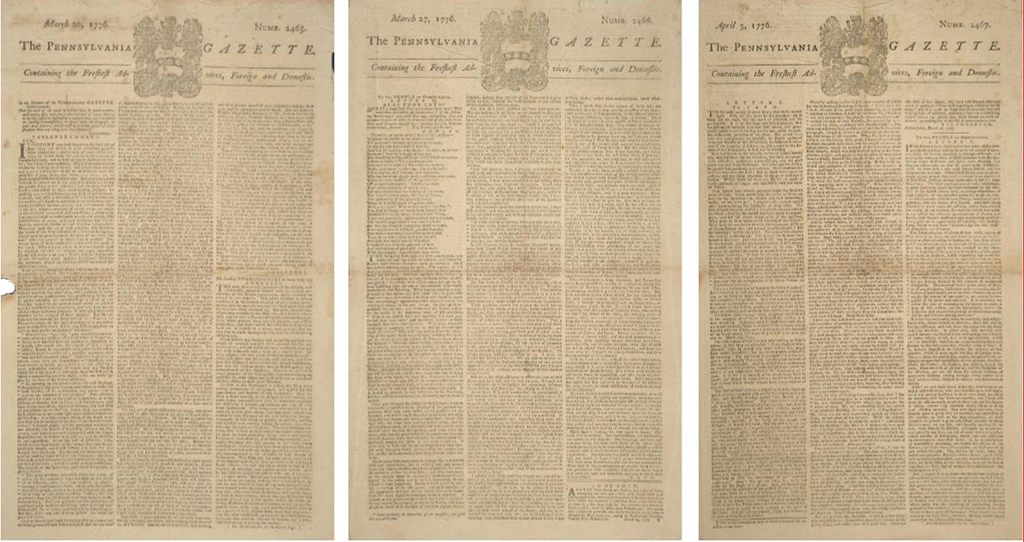
Copies of the Pennsylvania Gazette, March 20, March 27, and April 3, 1776. (Kislak Center)
First: These pieces are long. Early American newspapers can seem dense with type to modern readers, but they are actually nearly always filled with lots of short excerpts. But here we have real essays that are surprisingly wordy. They also read as “academic,” highly rhetorical, almost like a kind of university debate. I wonder about the relationship between these printed, academic “letters,” and the arguments that must have been taking place in the College, in the coffeehouses, and in the printing shops of the little city of Philadelphia.
Second: They are on the “front pages”: page one, often continuing onto page four and sometimes also page two. This is the outer form, and Jim reminded us that “normally the outer form, that is pages one and four, were printed first and was mostly ads.” But these letters take up a lot of printed real estate. It’s as if the normal economy of the newspaper trade—the need to fill up the paper with ads—was put aside for these debates. Perhaps it’s one of the first examples in American journalism where the “opinion” columns come to be featured—and also one of the first examples when what was on the “front page” mattered a lot. The placement of these articles also raises some questions about composition. How much time did each printer have to prepare these articles? The answer might depend a lot on whether a newspaper printer was issuing one or several of these letters for the first time—or repeating what had already been printed in another paper.
Third: Why did nearly all of the papers want to reprint the same pieces? Jim stresses that these papers were coming to a certain kind of ideological conformity during these months. Did readers perceive any differences in how the pieces were presented by different printers? If readers (as Jim suggested yesterday) had multiple newspaper subscriptions, wouldn’t this have seemed a bit redundant? And yet all of these radical printers—and particularly Dunlap and Hall and Sellers—featured the debate. Why?
Fourth: was anyone fooled by pseudonyms, or did everyone know who the writers were? Was Smith or Cannon in the room when they were being typeset or proofed? That’s especially true because this feels not like a national but instead like a hyper-local debate. The letters were only reprinted in Maryland, nowhere else. It’s true that Philadelphia is the place where the Continental Congress was meeting, so it was in a sense a national discussion. But my point here is that, maybe, all newspaper politics, like all politics as Tip O’Neill famously said, is local.
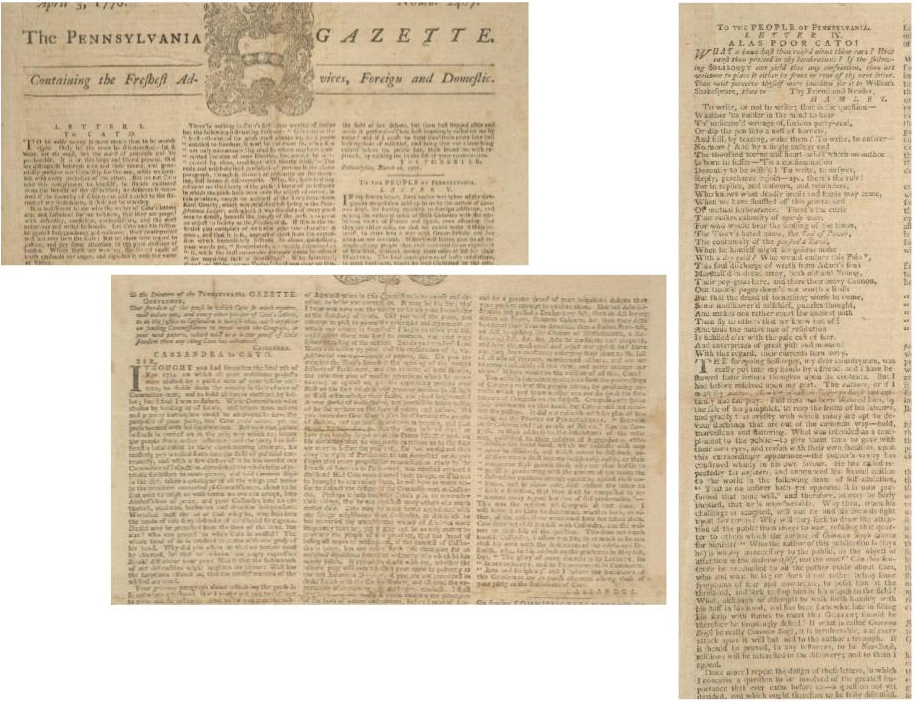
Details from the Pennsylvania Gazette, March 20, March 27, and April 3, 1776. (Kislak Center)
Liberty and a Free Press?
It’s misleading, I think, and anachronistic, to invoke terms like “loyalist” and “revolutionary” when reading these essays in letter form. Those identities did not yet have the meaning they would soon take on, after July 4. Instead, I’m hearing something else as I read through these debates, and it takes me to the third part of my presentation: Liberty and a Free Press? Part of the argument that begins in March 1776 between “Cato” and “Cassandra,” Smith and Cannon, seems to be about the right to speak openly, in print and in the press.
Here is Cato in The Pennsylvania Gazette, on March 13, 1776: “Grievous as the least restraint upon the press must always be, to a People entitled to Freedom, it must be the more so, when it is not only unwarranted by those to whom they have committed the care of their Liberties, but cannot be warranted by them, consistent with liberty itself.”
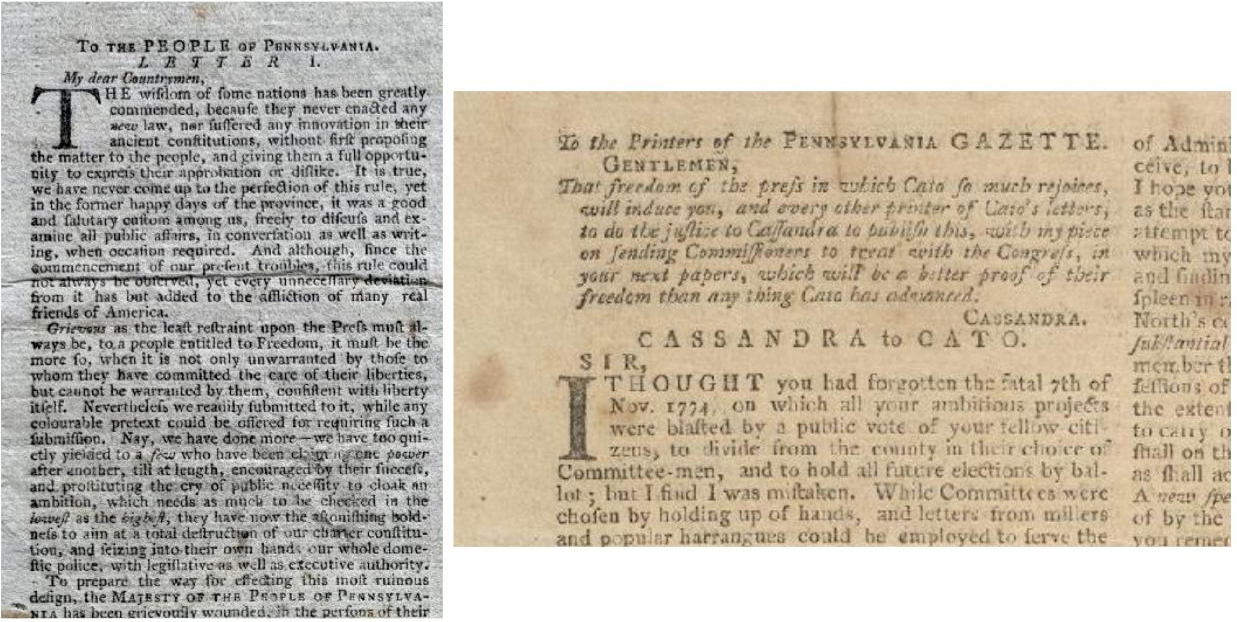
Details from the Pennsylvania Gazette, March 13 and March 20, 1776. (Kislak Center)
And Cassandra, on March 20, 1776: “That freedom of the press in which Cato so much rejoices, will induce you, and every other printer of Cato’s letters, to do the justice to Cassandra to publish this, with my piece on sending Commissioners to treat with Congress, in your next papers, which will be a better proof of their freedom than any thing Cato has advocated.”
It’s a bit opaque, but it sounds to me like a kind of “equal time in the media” argument. You’ve listened to him—but you need to give me space. If you publish their argument, you must also print mine.
One of the arguments that Jim makes in his remarks and in his Library Company exhibition relates to a topic that is just as topical now as it was in the 18th century: the “freedoms of the press and of speech”—or perhaps we might say, the freedom to speak in print. Who was and who is “free” to speak truth to power—in Philadelphia in 1776, or in the United States in 2026? And what did, and does, “liberty of the press” mean for printers and for political leaders? Are those who would ask hard questions of political or military leaders acting as servants of the public? Or are they traitors to the national cause? Jim’s work pushes us to question the history of a dogma so dear to American ideology that we rarely examine it: the notion that freedoms of speech and of the press—are the fundamental blood and fiber of our national being—the essence of what we fought for in the Revolution.
These freedoms had been debated throughout the later seventeenth and eighteenth centuries in Anglo-American political spheres. Young Benjamin Franklin had been involved in one such controversy when he and his brother James printed satirical pieces that bothered the leaders of the colonial Massachusetts Assembly. Echoing radical Whig writers from England, Franklin, writing as Silence Dogood, had published these words: “Freedom of Speech is the great Bulwark of Liberty; they prosper and die together.”19 Later, Franklin argued that his Pennsylvania Gazette adopted a careful strategy of attempting to print a balance of points of view while avoiding the risk of libel lawsuits.20 Franklin and his printer colleagues didn’t propose an unlimited press freedom: rather, theirs was a vision of the newspaper as a space for public debate upon civic matters. Citizens had the right or the “liberty” to question their leaders and their governments. The formulation of these freedoms took iconic form in the 1776 Pennsylvania Constitution, likely drafted by Franklin: “That the people have a right to freedom of speech, and of writing, and publishing their sentiments; therefore the freedom of the press ought not to be restrained.”
It sounds great. But not so fast, Jim cautions us. Philadelphia’s radical printers became, along with the other artisans and tradesmen leading a profound transformation of the colony during that fateful year, a kind of cabal. They worked to evict residents, including printers, who could be labeled as loyalists. It is likely that the citizen committees, who were essentially managing civic and political affairs, closely watched the work of the city’s printers.
Lynne Farrington and I investigated a very similar phenomenon during the French Revolution in the 1790s. After an initial period of press “freedom” in which Paris was flooded with every kind of radical, conservative, and frankly crackpot kind of printed political opinion, authorities grew increasingly worried about the survival of their revolutionary aims and ideals and worked to restrict the very presses that they had once encouraged. In the 1790s United States, the moment of backlash against what the government perceived as excessive press “freedom” came with the Sedition Act of 1798.
So here is the paradox: the most democratic, most politically “radical” of states, Pennsylvania, may also have been the site of some of the greatest press coercion. Revolutionary leaders were as willing to consider press restrictions and censorship as the leaders they had overthrown in the name of “liberty of the press.”
In this context of this emergent climate of constraint, the newspaper debates around Common Sense do stand out. For a few months, at least, these newspapers did seem to showcase the kind of press freedom that all sides claimed to stand for. For Smith, Cannon, and Paine, the debate was not just about what they were saying but about their right to say it—and about the right, or perhaps even the duty, of the newspapers to print it. From mid-March to early May 1776, Hall and Sellers’s Gazette and Dunlap’s Packet did that: their newspapers give us an extraordinary spread of a multivocal debate about the colony’s future.
Perhaps, though, that moment of open debate was not a long one. Where did some of the voices go? I’ll conclude by returning to a printer with whom we began: the intriguing Robert Bell. Bell did not run a newspaper, but he was strongly committed to the revolutionary cause. After the quarrels with Paine over the publication of Common Sense, however, his reputation may have suffered in that radical community. As Jim has noted, he remained in Philadelphia during the Revolution and the occupation of the city but “retreated,” in a sense, into the publication of small-format literary works.
One area in which Bell would not retreat, however, was in expressing his ideas on freedom of expression and freedom of “speech in print.” And one of the interesting ironies of the 1776 debates is that Bell not only printed Common Sense but also the most important response to it in pamphlet form, a text entitled Plain Truth—which was the title that Benjamin Rush later claimed he had suggested to Paine for his pamphlet.
This Plain Truth presents a harsh critique of Paine, arguing that his “scheme of Independence” would be “ruinous, delusive, and impracticable.” The author wrote as “Candidus,” and the identity of Candidus was never certain during the period. Jefferson suspected it to be Alexander Hamilton, and others likely thought it was Provost William Smith. In the 1950s, Thomas R. Adams established its author to be James Chalmers, a Marylander.21 Smith does have a contribution here, though, in an excerpt from one of his “Cato” newspaper articles. The excerpt includes Smith’s famous put-down of Cassandra (James Cannon) and, implicitly, of Paine: “He seems to have drank deep of the cup of independency; to be inimical to whatever carries the appearance of peace; and too ready to sacrifice the happiness of a great continent to his favorite plan.”
This pamphlet actually represents the ways in which newspaper debates could make their way into pamphlet publication. In his study of Plain Truth, Adams noted something striking: it was issued on March 13 and contains an extract by Cato published in the Gazette that same day.22 So here Bell was taking material directly from The Pennsylvania Gazette into his pamphlet Plain Truth. We might also imagine that Smith himself worked with Bell on creating this extract.
Adams uncovered “seven different variants of Plain Truth printed by Robert Bell between March 13 and May 8, 1776.” To him, this proved the “disorganized” actions of the anti-independence campaign and the “incoherence” of their strategy. I’m not so sure: it might just as well prove that Bell was rushed to meet a surprisingly large demand for a work whose impact we have, thanks to the shadow of Paine and his allies, underestimated.
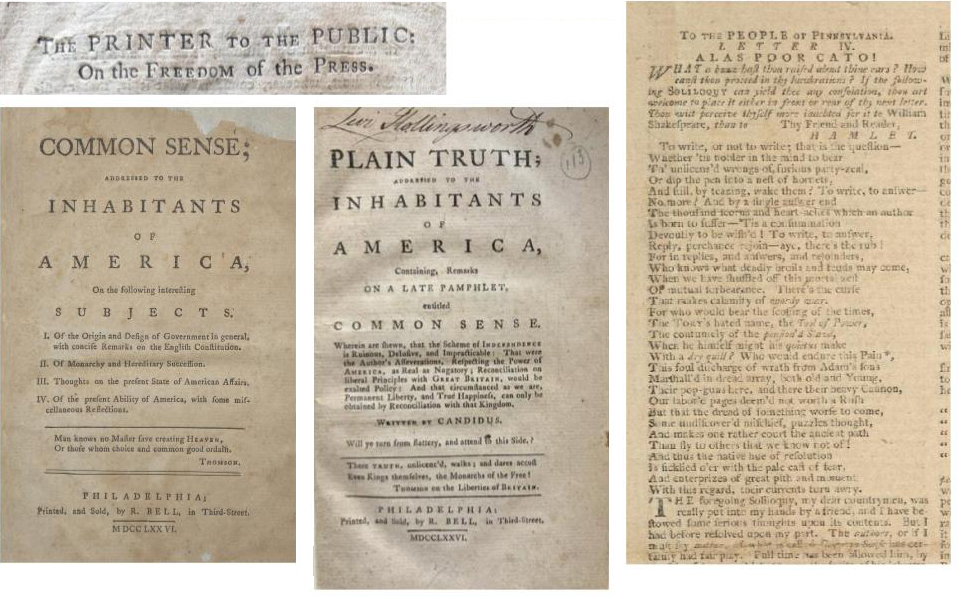
But why would the freethinking republican printer Bell take a chance with this anti-independence collection? And risk his reputation further by consorting with the controversial Provost Smith? Perhaps Jim can suggest some answers there. I’ll just propose one version of an answer, maybe the answer that Bell himself wanted his readers to believe. All or some copies of Plain Truth include an extra leaf—only one of Penn’s copies, still in its original stab-stitched condition, has it. I show it to you here: “The Printer to the Public: On the Freedom of the Press.” I’ll just read the opening of this leaf, an amazing piece of rhetoric, and I leave to you to judge if this was an effective use of a lot of small capitals in the font:
The Printer to the Public: On the Freedom of the Press.
Having very lately, without any other authority, than the Liberty of the Press, ushered into the hands of the public, certain speculations for American Independency.
By the same Authority, vis. The Liberty of The Press: ROBERT BELL, Provedore to the Sentimentalists; hath printed, published, and is now selling (Price Three Shillings) to all who are capable of practicing so much impartiality, as to give a hearing to the other Side, by lending their attention towards certain speculations.
Against American Independency.
And that no malicious person, or persons, may plead ignorance of this indubitable and firmly established authority, The Liberty of the Press, which doth, and forever will prevail in all those countries, where Freedom is the basis of their Constitution, The Printer, hath hitherto subjoined, the following very substantial and definitive Testimonies.
And then I’ll show you the verso: the title page of Plain Truth—right next to Bell’s advertisement for his own 3 shilling edition of Common Sense.
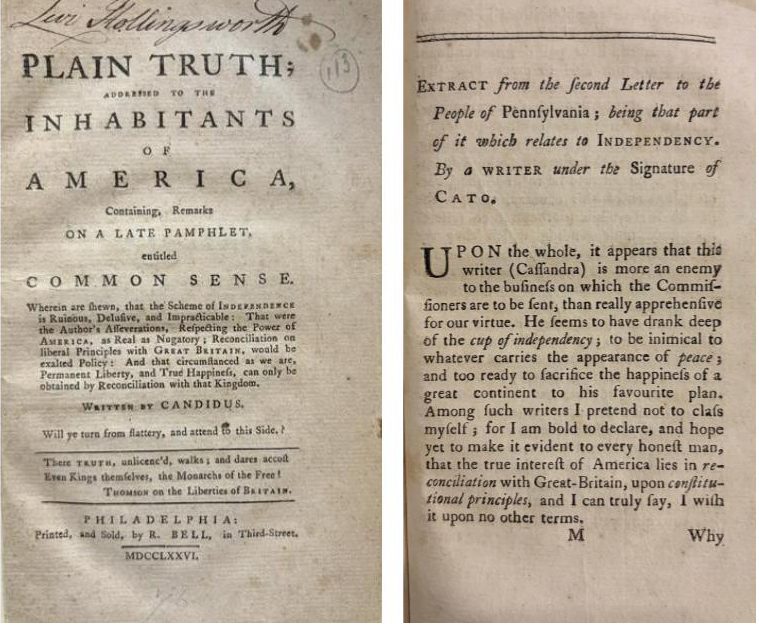
Plain Truth; addressed to the Inhabitants of America: containing, remarks on a late pamphlet, entitled Common Sense … Philadelphia : Printed, and sold, by R. Bell, 1776 (Kislak Center, AC7 C3533 776p, one of four states printed in 1776).
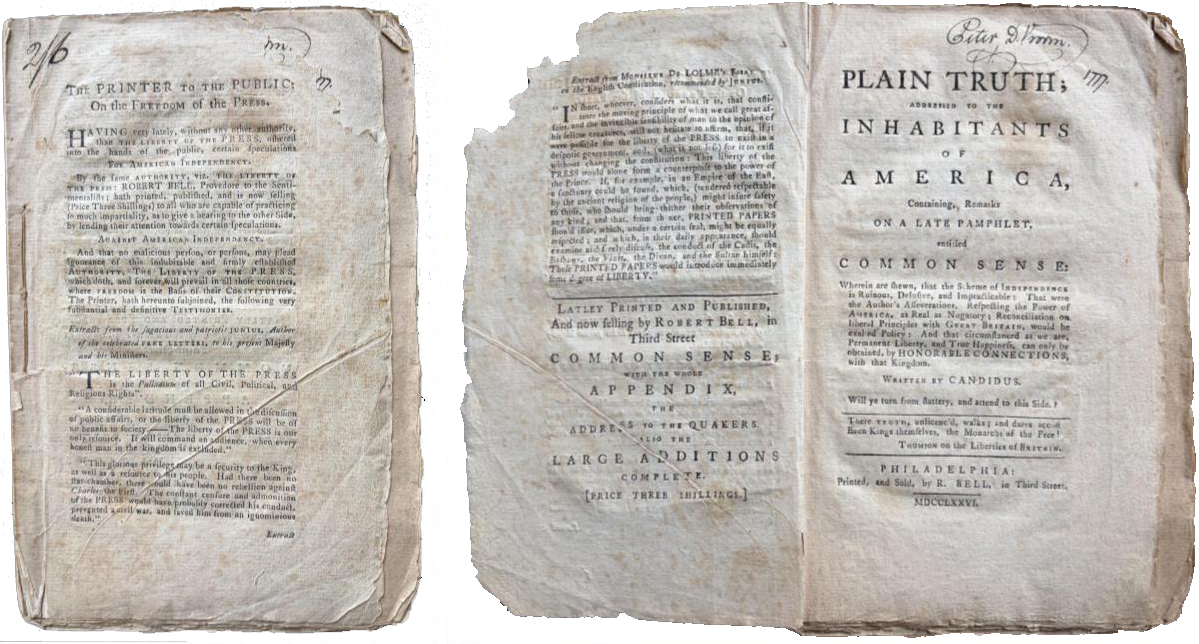
Plain Truth; addressed to the Inhabitants of America: containing, remarks on a late pamphlet, entitled Common Sense… Philadelphia : Printed, and sold, by R. Bell, 1776 (Kislak Center, AC7 C3533 776pc, with “The Printer to the Public: on the Freedom of the Press”).
Bell was playing an amazing game here. His vision of the American printer was very much at odds with the emerging radical consensus. And it’s a version of American “radicalism” that seems to have been lost after those first complex months of 1776. Perhaps there were many different kinds of “radical printers” in 1776—and thanks to Jim, perhaps we can work to recover them all.
Footnotes
- 1 James N. Green, curator, Philadelphia’s Radical Revolution: From the Stamp Act to the Federal Constitution, exhibition, The Library Company of Philadelphia, May 18–October 9, 2026.
- 2 J.M. Duffin and John H. Pollack, curators, Revolution at Penn? The University of Pennsylvania during the American Revolutionary Era, exhibition, Kislak Center for Special Collections, Rare Books & Manuscripts, University of Pennsylvania Libraries, February 13–August 29, 2025. Available online at: https://penn.manifoldapp.org/projects/revolution-at-penn.
- 3 Jessica Peterson et al., “The Typography of Independence,” Common Press, University of Pennsylvania Libraries, 2025–26: https://www.library.upenn.edu/events/typography-independence.
- 4 Lynne Farrington and John H. Pollack, curators, The Time to Right All Wrongs: France, Haiti, and Philadelphia in a Revolutionary Age, exhibition, Kislak Center for Special Collections, Rare Books & Manuscripts, University of Pennsylvania Libraries, February 26–September 4, 2026.
- 5 This and subsequent citations to this letter from Benjamin Rush to James Cheetham, Philadelphia, July 17, 1809, in Letters of Benjamin Rush, Digital edition, ed. Lyman H. Butterfield (Princeton University Press, 1951; University of Virginia Press, 2022), electronic edition via https://rotunda-upress-virginia-edu.
- 6 Rittenhouse is not mentioned by Rush in his letter to Cheetham. For the claim that Rittenhouse read a draft, see Eric Foner, Tom Paine and Revolutionary America, updated edition (Oxford: Oxford University Press, 2005), 109.
- 7 J. M. Duffin and Nancy Hagedorn, “Philadelphia in 1775: Map Displayed in the ‘Revolution at Penn?’ exhibition, Penn Libraries, Spring 2005,” https://storymaps.arcgis.com/stories/42a8107416c94c5cbfd92ded2050dbff.
- 8 On Aitken, artisan solidarity, and Pennsylvania Magazine, see Foner, Tom Paine and Revolutionary America, 38, 72–73.
- 9 Foner, Tom Paine and Revolutionary America, 109–16.
- 10 Pierre Eugène Du Simitière, “Old Academy & Charity School, 4th below Arch. Philad.,” drawing, pencil on paper, n.d. [before 1778?], Library Company of Philadelphia, Pierre Eugène du Simitière collection.
- 11 Bernard Bailyn, The Ideological Origins of the American Revolution (1967; enlarged ed., Belknap Press of Harvard University Press, 1992), 1–8.
- 12 Even bibliographers before Bailyn seemed to have shared this point of view, so perhaps Bailyn was himself following a kind of bibliographical orthodoxy that saw Common Sense as a kind of ending point. Thomas R. Adams, for example, wrote in 1955 that “Common Sense brought to an end the war of the pamphlets, that literary outpouring of ten years in which all the issues in conflict between Great Britain and the colonies had been debated.” Adams wrote those words in a study of an anti-Paine pamphlet called Plain Truth, to which I will return shortly—but he prefaced his study of Plain Truth by saying that these anti-Paine works were of little significance compared to Paine’s text: “only two” pamphlets appeared in opposition to Paine’s, and “they had but little effect.” Thomas R. Adams, “The Authorship and Printing of ‘Plain Truth’ by ‘Candidus,’” The Papers of the Bibliographical Society of America 49, no. 3 (1955): 230. One of the great bibliographers of the publications of the revolution, Adams began his work on this topic when a curator in the rare book department of the University of Pennsylvania Library, in the early 1950s.
- 13 Joseph M. Adelman, Revolutionary Networks: The Business and Politics of Printing the News, 1763–1789 (Johns Hopkins University Press, 2021); Emily Sneff, When the Declaration of Independence Was News (Oxford University Press, 2026).
- 14 Benjamin Rush, The Autobiography of Benjamin Rush, His “Travels through Life” Together with His Commonplace Book for 1789-1813 (Memoirs of the American Philosophical Society 25; published for the American Philosophical Society by Princeton University Press, 1948), 114–15.
- 15 On Cannon, see Sophia A. Rosenfeld, Common Sense: A Political History (Harvard University Press, 2011), 160.
- 16 Richard Alan Ryerson, The Revolution Is Now Begun: The Radical Committees of Philadelphia, 1765–1776 (University of Pennsylvania Press, 1978), 40ff. William Smith, “Notes & Papers on the Commencement of the American Revolution by Dr. Wm Smith,” manuscript, n.d. [18–?], Am .159, Historical Society of Pennsylvania.
- 17 Christopher A. Hunter, “William Smith’s Catonian Loyalism, Race, and the Politics of Language,” Early American Literature 52, no. 3 (2017): 531–58. Chart on 558.
- 18 Foner, Tom Paine and Revolutionary America, 123–7. Gary B. Nash, “Philadelphia’s Radical Caucus that Propelled Pennsylvania to Independence and Democracy, in Revolutionary Founders: Rebels, Radicals, and Reformers in the Making of the Nation, ed. Alfred F. Young, Gary B. Nash, and Ray Raphael (New York: Vintage Books, 2012), 73.
- 19 Benjamin Franklin as Silence Dogood, The New England Courant, July 9, 1722. Franklin borrows these words from John Trenchard and Thomas Gordon in The London Journal, February 4, 1721.
- 20 See Franklin, The Autobiography of Benjamin Franklin,, ed. Leonard W. Labaree et al. (1964; Yale University Press, 2003), Part 3, 165.
- 21 Thomas R. Adams, “The Authorship and Printing of ‘Plain Truth’ by ‘Candidus.’” The Papers of the Bibliographical Society of America 49, no. 3 (1955): 230–48.
- 22 “Signature M contains the ‘Extract from the second letter … of Cato’ by Provost William Smith which first appeared in Hall and Sellers’s Pennsylvania Gazette on March 13, the very day on which the first issue of Plain Truth was advertised to appear. The extract was lifted verbatim from the last half of the letter. We do not know whether Bell had access to the text before publication, or to an advance copy of the newspaper, or whether he delayed publication to insert the new material. In any case his shop must have been busy with last minute alterations which might have produced the odd condition of signature L.” Adams, “The Authorship and Printing of ‘Plain Truth’ by ‘Candidus,’” 243.