
Two Printings, Two Looks: The Philomathean Rosetta Stone Report
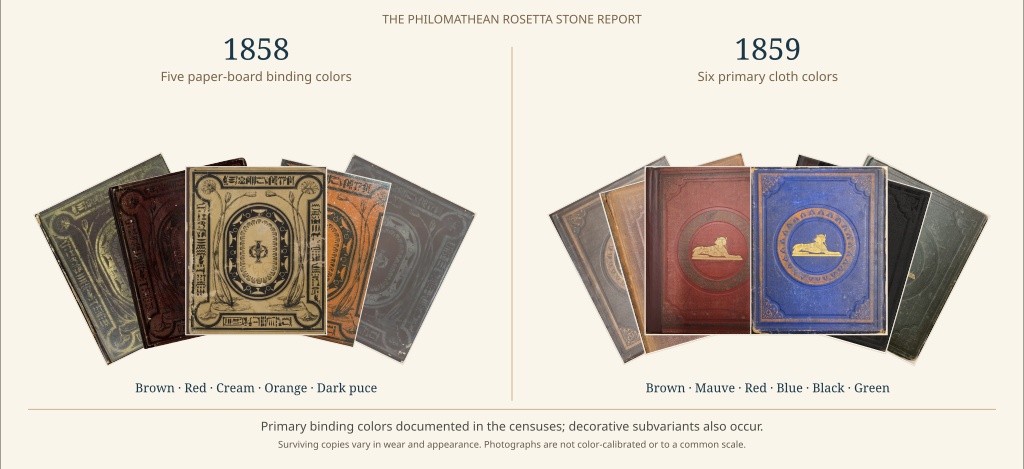
Five documented paper-board binding colors of the 1858 Philomathean Rosetta Stone Report, left, and six primary cloth colors of the 1859 edition, right. Decorative subvariants also occur. Surviving copies vary in wear and appearance; photographs are not color-calibrated or to a common scale. Image credits at bottom of the page.
In 1858, three young members of the University of Pennsylvania’s Philomathean Society published the first complete English translation of the Rosetta Stone. Their Report explained the ancient decree preserved in hieroglyphic, Demotic and Greek inscriptions, drawing on the work of earlier scholars. It also became an extraordinary achievement in American printing.
Charles R. Hale translated the Greek and Demotic texts and helped with the hieroglyphic work. Henry Morton undertook the hieroglyphic translation and pictorial design. Samuel Huntington Jones contributed the historical essay on Ptolemy V Epiphanes, the king honored by the decree.
The Report’s pages were produced throughout in manuscript lithography and chromolithography, bringing handwritten scholarship, Egyptian figures and elaborate ornament together. The Grolier Club describes it as one of the first books produced entirely by chromolithography in America. It was printed at Louis N. Rosenthal’s Philadelphia establishment.
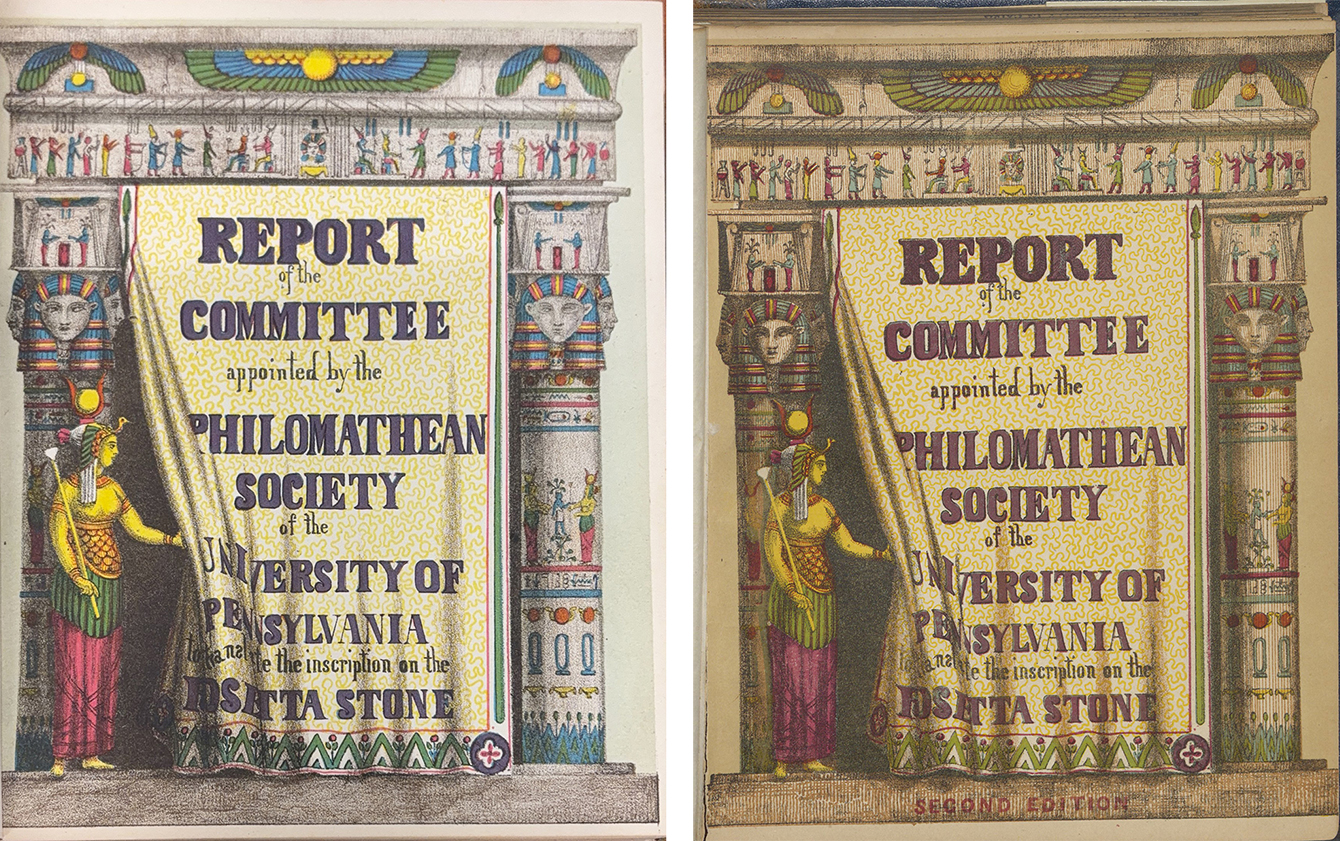
Title pages. Left: First edition, 1858. Rosetta Stone Bibliographical Census, C017. Right: Second edition, 1859, with “SECOND EDITION” in red block letters at the foot. Rosetta Stone Bibliographical Census, S051.
Four hundred copies appeared in 1858, followed by 600 in 1859. Comparing the editions reveals extensive redesign alongside smaller corrections. Comparing surviving copies also helps distinguish original features from later damage or rearrangement.
The first edition’s pagination makes that distinction important. Its numbers jump from 72 to 81. Later, after the hieroglyphic translation ends on an unnumbered page conventionally designated [128], Jones’s section begins again at 113. Its sequence runs through 120 before jumping to 129. The overlap occurs where separately prepared contributions meet, consistent with the explanation Randolph G. Adams offered in 1924. These irregularities occur across copies and need not indicate missing leaves or a binder’s mistake.
The second edition revised the numbering, but some designs retained obsolete numerals. A page occupying position 98 still reads 106. Another, intended as 112, reads 211. Following the text and illustrations is more reliable than following the numbers alone.
The visual changes are easier to see. The 1858 dedication to Henry D. Gilpin places elaborate lettering within dense botanical ornament. In 1859, an open oval holds the words, surrounded by trees, a standing figure and a sphinx. The preface’s slender floral garland becomes a rectangular panel with large flowers. Letterforms and line endings change with the designs.
Other revisions preserve much of a page. First-edition page 127 describes a festival lasting to the “fifteenth” day. On its second-edition counterpart, page 119, this becomes “fifth,” with dashes filling part of the shortened space. Nearby, “priests belonging to Egypt” becomes “priests of temples of Egypt.” The surrounding handwriting and botanical frame remain recognizable.
Surviving copies also show variation within an edition. The second-edition title designation appears in red block capitals in some copies and faint cursive lettering in another. That difference deserves recording without prematurely declaring a separate issue or printing sequence.
✧ ✧ ✧
After finding an inscribed 1858 copy at a North Carolina estate sale in March 2026, I began compiling the Rosetta Stone Bibliographical Census to bring the surviving copies into comparison. Maintained online from Texas as two separate public registers, the project records bindings, title-page states, pagination, inscriptions, provenance and photographs for copies in libraries and private collections across North America, Europe, Egypt, Japan and Australia—97 first editions and 98 second editions as of 7 November 2026.
The census welcomes photographs and reports of copies in libraries, private collections and historical sale records. Title pages, bindings, inscriptions and small printing differences all contribute. Private owners may remain anonymous. Each additional copy gives us another chance to understand how this unusual collaboration reached the printed page. Census websites: 1858 edition | 1859 edition.
Reference for the chromolithography description: Grolier Club exhibition entry.