The Radical Printers of Revolutionary Philadelphia
 Keynote. I am deeply honored to have been invited to address the annual conference of an organization I’ve been associated with since I was a student in Columbia Library School’s rare books program fifty years ago. My sincere thanks to the conference organizers and our hosts at Penn, Lynne Farrington, John Pollack, and Jessica Peterson, as well as to Virginia Bartow and members of the APHA board for helping all of us celebrate the 250th anniversary of the signing – and the printing – of our nation’s founding document here in Philadelphia.
This paper is an offshoot of an exhibition now on display at the Library Company, called Philadelphia’s Radical Revolution. I hope some of you had a chance to see it today. It draws heavily on the collection of political ephemera printed in Philadelphia from 1764 to 1784, formed by the Swiss emigré Pierre Eugène Du Simitière. His collection, acquired by the Library Company in 1785, included over 1500 political pamphlets, broadsides, and handbills, a high proportion of which are the only known copies. But Du Simitiere collected newspapers just as exhaustively as printed ephemera, and they are equally important as documents of the Revolution in Philadelphia. In preparing the exhibition I learned a lot about the role newspapers and their printers played in the Revolution, and I’d like to share some of that with you today.
So, who were these printers, and why do I call them radical?
In Pennsylvania, revolutionary change was sudden and profound, and it proceeded at warp speed. Even before the Declaration of Independence abolished all forms of colonial government, the most ardent patriots had begun the process of drafting a new state constitution in a convention elected on June 18, 1776. With Benjamin Franklin presiding, the result of the convention’s deliberations turned out to be the most radical and democratic of all the revolutionary state constitutions. It was adopted on September 28, making today an only slightly belated 250th birthday for that amazing and much too little-known document.
The constitution’s most radical provision was extending voting rights to all free adult male taxpayers, which included many artisans, working men, and farmers, many of whom owned no property. Universal male suffrage was an idea that had occasionally been proposed in the past but never actually implemented. Even free Black men could vote as long as they paid even a shilling a year in tax. Also unprecedented was its vesting almost all state power in a unicameral legislature (called the Assembly) which, given this very non-elite electorate, was dominated by a new party called the radical party. They came to power just as the British Army was advancing toward Philadelphia, and fearful of enemies within, the radicals quickly passed laws that denied all civil rights to any man suspected of loyalist sympathies or who refused to sign an oath renouncing all allegiance to Britain. In short, the radicals enfranchised huge numbers of men who had never voted before, and at the same time disenfranchised much of the old elite, thus cementing their grip on power for the duration of the war.
This is key to understanding how and why most of the Philadelphia printers and journeymen (who after all were artisans) came to back the radical government. Except during the 9-month occupation by the British army, there was no loyalist press in Philadelphia. Shortly after July 4, one loyalist newspaper printer was driven out of town and another’s shop was burned down; the city’s German newspaper was pro-independence but not a supporter of the radical party; and (as we shall see) there were important printers who did not publish newspapers. But this afternoon I want to focus on the three men who printed and edited the main Philadelphia newspapers, and who all supported—and were supported by— the radical party.
They were John Dunlap, a 30-year old immigrant from Northern Ireland who published the Pennsylvania Packet; Thomas Bradford, also aged 30 and a great grandson of the city’s first printer, who published the Pennsylvania Journal; and the firm of Hall and sellers, publishers of Franklin’s old paper the Pennsylvania Gazette. Dunlap and Bradford were both militia officers, and because the militia were one of the chief bases of radical power, they were most closely aligned with the ruling party. Hall and Sellers were careful not to appear disloyal to Franklin, who was the elder statesman of the radical party, but they were less enthusiastic supporters of the radicals than the other two.
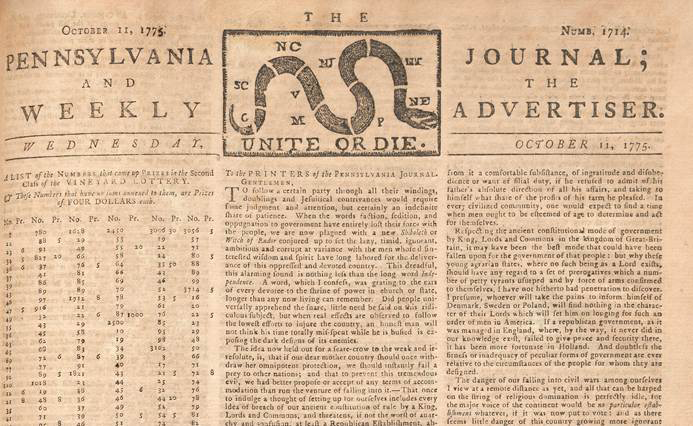
If all three papers were more or less aligned with the radicals, were there any differences between them? I’ve concluded that by far the most important difference lay in their publication schedules. The more conservative Gazette stuck all through the war with Franklin’s old schedule, once a week on Wednesday. The other two began with once a week but varying the day, in order to better catch the weekly mail deliveries from north and south. As news of resistance and war exploded in the early 1770s, however, these traditional channels sometimes proved inadequate. For example, long before his famous midnight ride, Paul Revere made marathon rides to New York and Philadelphia carrying news of the Boston tea party, which could not wait for the post rider, and of Britain’s Intolerable Acts, which could not wait for ships to arrive in the more distant southern colonies.
Traditionally all newspapers had the option of responding to breaking news by occasionally printing a single extra half-sheet to be distributed on days when a regular issue did not appear. As the war expanded, these postscripts (as they were called) were at times called for almost every week. But it soon appeared they were not enough.
The response of the three papers to the flood of news and to wartime disruptions is telling. In the winter of 1777–78, when the British army occupied Philadelphia, Dunlap’s Packet moved to Lancaster, Pennsylvania, and on his return to Philadelphia, it shifted from one to three days a week. Then in the fall of 1783 it changed its format from 3 to 4 columns, and a year later it became a daily (except Sunday), the first successful one in America. The next year it shifted to larger paper, from about 16” to 19” in height, or from royal to medium to use the terminology of the period. Bradford’s Journal shut down during the occupation and later began to publish twice a week but kept its former format. The Gazette combined these approaches, moving to Lancaster during the occupation but never varying its old weekly schedule. Both were far more cautious in their response than the Packet.
More frequent publication obviously allowed a newspaper to print fresher news at a time when it was increasingly urgent; but it also allowed a newspaper simply to print more news. Thus, over the course of the war, the Packet went from 12 columns a week in 1771 to 96 in 1784, and eightfold increase. In the midst of this expansion, Dunlap promoted his apprentice David Claypoole to full partnership, and presumably he also added more presses and personnel: he advertised regularly over these years for a “journeyman printer, who is a good pressman,” promising “constant employ.” Before the war he sometimes used larger type for important news, pica or small pica, equivalent to 11 or 12 point. But during the war, when he was trying to pack in all the news he possibly could, almost all text was densely set in long primer or 10 point.
And of course, Dunlap required a lot more paper than the others, at a time when imported paper was not available, local supplies were sometimes interrupted by military activity, and rags were in chronically short supply. He advertised hundreds of times over the war years for clean white rags, offering the highest prices. In his ads, the word RAGS is sometimes in printed in his largest type, as if shouting out his need.
The paper itself shows that Dunlap struggled to source it. It varies in color from almost white to coarse and brown, and in weight from oddly thick at one extreme to nearly tissue-thin at the other. Like most newsprint at the time, it is mostly unwatermarked, but here and there I have found marks of Mark Wilcox’s Ivy Mill in Delaware County, Pennsylvania, and Christopher Saur II near Germantown. When Dunlap printed in Lancaster during the British occupation, he used paper with a watermark that John Bidwell believes is French. How it got there is a mystery, but it seems he would take paper from anywhere he could find it.
The Saur watermark raises the possibility that the unmarked paper Dunlap mostly used might have come from the stockpile Saur amassed for his huge 1776 edition of the quarto Bible in German. Its publication was interrupted then Saur was denounced as a loyalist and his property was seized. John Bidwell thinks the mill might have been rented at this time to Joseph Crukshank, who printed for the Quakers – religious books and abolitionist pamphlets, along with almanacs, spellers, and standard school books, and two of the earliest American editions of the New Testament – but never a newspaper. Pacifists and suspected loyalists, Quakers were pariahs in the radical state. Crukshank, also constantly advertised in the Packet for rags.
Though I keep talking about news, I can’t neglect advertising, which was essential to the viability of all newspapers. The amount of advertising varied seasonally and with the disruptions of war, but by and large the percentage of columns devoted to ads in the Packet stayed remarkably steady at about 60% even as it radically expanded. Normally the outer form, that is pages one and four, was printed first and was mostly ads. The inner form was usually mostly news and was set last and printed close to the day and time of publication. More news, then, went hand in hand with more advertising to pay for it.
A lot of the news that was filling these newspapers was really government printing, and the new government was producing it in unprecedented quantities. In the summer of 1776, for example, the Continental Congress was meeting in Independence Hall and was also drafting the Articles of Confederation. The Convention drafting the state constitution met two blocks away in Carpenter’s Hall, and was also the de facto state government. Extra-legal committees like the Committee of Safety and the militia’s Committee of Privates took over much of the city government. Quite often informal committees called public meetings in places like the American Philosophical, Society or in the yard of Independence Hall, where thousands of “respectable citizens” (as they were always called) could participate. All these bodies at least tried to have their proceedings published, but it seems there was not always room in any one newspaper at any given time, even though the governing bodies paid well. The effect of all this was that people who seriously wanted to keep up to date and get the full picture of what was happening had to subscribe to more than one newspaper.
Parenthetically: Dunlap declined government payment in increasingly worthless paper money, opting instead for payment in vacant land just outside the built-up area of the city, some of it confiscated from loyalists. After the war, this made him a very wealthy man.
An important stipulation of the state constitution was that all bills submitted to the Assembly had to be printed in at least one newspaper. This had a huge impact on the conduct of newspapers. One bill could take up most of a page, sometimes even displacing ads from the front page. The most transformative bills were also later published as pamphlets, but the newspaper texts were in most cases the first, and in some cases the only texts of laws most people ever saw.
The Packet had the most capacity for this avalanche of government print, and that cemented its position as the favored paper of the radical party. In this way, the frequency of publication was itself an indication of a paper’s editorial policy, in the sense of how engaged it was in the radical agenda. Thomas Bradford was certainly aligned with the radicals, but in addition to the newspaper, he had the family coffee house and book store to run, and his father William had left the business in order to serve at high rank in both the state militia and the Continental army. This may explain why he could not expand his newspaper’s capacity as much as Dunlap did. Meanwhile the venerable Gazette, still just once a week, was the last place you would look for important news and information, but it was still supported by the old elite.
Another somewhat counter-intuitive indication of the engagement of the Packet the fact that it was first choice for those who opposed radical government to express their opinions, and for the radicals to reply to them. As Benjamin Rush wrote in an unpublished memoir, Dunlap was “a staunch Revolutionary Whig, and active as a dragoon in the most perilous stages of the war, [but] in the parties which divided the country he was always moderate, candid and just to both sides.” Rush’s recollection (written in 1810) may have been somewhat rose-tinted, reflecting the fact that throughout the 1790s, when Federalist and anti-federalist newspapers became insanely hyper-partisan, the Packet remained the one paper everyone read.
These three newspaper printers occupied prime real estate along the first two blocks of Market Street, which (I am happy to report) the Philadelphia visitors’ bureau has just recently begun to refer to as Printers’ Row. Also on that same row was the Scots immigrant Robert Aitken. He never published a newspaper, but he played a major role as printer of the journals of Congress; as publisher of the first American edition of the English language Bible, which was authorized by Congress; as publisher of the short-lived Pennsylvania Magazine, edited by Thomas Paine; and as the best bookbinder in America.
The other key figure was Robert Bell, a veteran of the Scottish and Irish bookselling trades. He too never published a newspaper and seems to have outsourced much of his printing. Before the war he published by subscription reprints of big new British books like Blackstone’s Commentaries on the Laws England in four octavo volumes, and he was a book auctioneer and keeper of a circulating library and the largest book shop in the city. After Independence he was the only regular publisher of books in town, though now they were slim duodecimos.
Bell’s premises were on Third Street below Walnut, several blocks away from Printers Row. He is perhaps most famous today as the publisher of Thomas Paine’s pamphlet Common Sense, the subject of John Pollack’s paper tomorrow afternoon. Historians have focused on pamphlets as the medium for the most important revolutionary writing, but that was more true for the period leading up to the Revolution. Once the war broke out, pamphlets were increasingly augmented or replaced by publication in newspapers, often spread over several issues. Compared with pamphlets, newspaper publications appeared more quickly and were distributed more widely, and were risk-free for the to the publisher, provided he had the space. In the chaos and rush of war, newspapers were what the times required.
There is just one more printer that deserves to be included in this gallery, though I will not be calling him a radical. Benjamin Towne was a British-trained printer who migrated to Philadelphia and launched a stoutly pro-American newspaper in 1774. Called the Pennsylvania Evening Post, it differed markedly from its older competitors by being in quarto, appearing three days a week (the first Philadelphia paper to break out of the weekly straightjacket) and in the evening, which allowed him to capture an additional day’s news and advertising. Most issues were a single half sheet of four pages, but he sometimes expanded to eight if he needed the space. Its pages were numbered sequentially from issue to issue like a book, and each issue announced a price of two or three pence, which indicates it was available by the single issue. That may have been another first at a time when newspapers were available almost exclusively by subscription. All these innovations helped make the paper a success. In particular, the thrice weekly schedule allowed Towne to take his place in history as the first to print the Declaration of Independence in a newspaper, on Saturday, July 6. As you know, Dunlap issued the original broadside Declaration on Friday July 5, but it didn’t appear in his Packet or anywhere else in the public prints until Monday the 8th.
Towne has another less illustrious place in history. When 25,000 British soldiers occupied Philadelphia in September 1777, thousands of patriots fled to the country, and thousands of American Tories flooded in. As I mentioned before, our three newspaper printers either moved to the country with the government or suspended publication. Booksellers Robert Bell and Robert Aitken, however, stayed in town, ostensibly to protect their stores, but also to keep in business while they waited to see who would win the war. Bell’s circulating library became the resort of fashionable British officers and their loyalist friends, much to his later chagrin. Aitken continued to work on printing the Journals of Congress, but at one point someone talked him into swearing allegiance to the British. He later regretted it and after the occupation ended, he atoned by signing an oath of loyalty to the Americans. It was a treacherous and difficult environment for all printers.
Towne too stayed in the city. For a few days after the British marched in, his Evening Post was suspended, and then without explanation or apology, it reappeared as a stoutly Tory paper. On the first page was General Howe’s blanket pardon for anyone who had embraced the patriot cause, implicitly including Towne himself. Then, in short order the two loyalist printers who had been run out of town in 1776, re-emerged. Those two vanished almost overnight when the British withdrew in May of 1778, but Towne again stayed put and his paper once again became stoutly patriot, again without explanation or apology.
Shortly thereafter, Towne happened to meet Princeton president John Witherspoon in Aitken’s book shop. Witherspoon urged him to make amends with the public for his flip flop. Towne demurred, so Witherspoon agreed to ghost-write a humorous Apology for him, which was published by Bell. In it, Towne is made to say he was just looking after his own interest and in any case “I have been … a coward from my youth, so that I cannot fight; my belly is so big that I cannot run; and I am so great a lover of eating and drinking that I cannot starve.” How much this helped rehabilitate him I don’t know but he was not punished for his loyalist spasm, and his paper continued for a few more years, though more and more irregularly. For a few weeks in 1783 it was a daily, the first in America. (This was a year before The Packet became the first successful daily.) After that final flare, it sputtered out. Some say Towne personally hawked its last issues through the streets of the city.