
A PDF is Not a Book: the Illusion of Completeness
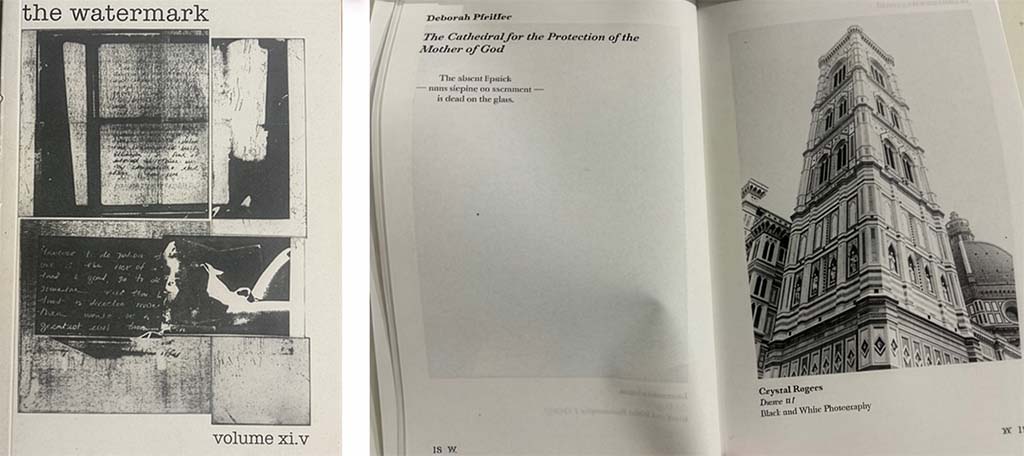
The Watermark, UMass Boston student literary magazine, 2004 (Carston Anderson)
Introduction
Let us say you, in your adventures as a student or a reader, come across an archive or a library of books. Let us also say that it makes claims of being official, mandated, or institutional, something along the lines of a special collections branch of a university archive, for example. It keeps its books in duplicate and makes PDF files available to you on occasion. This situation, while common enough, must be viewed by the engaged individual with some good-natured suspicion. After all, a PDF is not a book. And two exact copies of the same book might as well be one book.
Let us approach each issue separately through the lens of a single series of books from a single institution. This series is the undergraduate student literary journal The Watermark from The University of Massachusetts Boston. It was actively publishing books from 1993 to 2022. The institution is, naturally, UMass Boston, where I am currently a graduate student and have assembled my own near-complete run of physical books, allowing us to note several important things in what is usually assumed to be lower-tier cultural ephemera printed by students, distributed, and lost.
UMass Boston boasts a well-supplied library and archive apparatus on campus. They have both a near-complete run of physical copies of the books, like me, and a parallel system of digitized issues that almost completely overlaps with their physical holdings. The image they present, non-maliciously, is a deceptively complete image of neatness and organized distribution (when undergraduate literary publications are usually anything but that), and we would do well to remember it.
Part 1: Materiality Matters
We can intuitively understand that it is one thing to read something electronically and another thing to hold an item that exists and moves through the world, even if we cannot always articulate it cleanly. All the little things our hands notice suddenly go away with a PDF. How thick is the book? How is it bound? What size is it? Is it a tabloid-style magazine or is it more like a 6 × 9 trade paperback? Is it saddle-stitched with glossy paper or perfect-bound? These are things we absorb without active thought that go away when we only have a PDF to look at. And if the only two copies of a book are in an archive, and you only have access to that university-provided PDF, you are kept from making those unconscious connections and begin making assumptions.
But let us take this logic even further. A PDF, as a digital copy of a book, is only a digital copy of the one book that was scanned. It preserves the words on the page and flattens the context. What happens if you have two copies of the same book that are different from one another, but you only scan one? Furthermore, what if you have two copies of a PDF?
This is not just a hypothetical. In my research into The Watermark, I have held many copies of many different volumes. One such volume that attracted my immediate attention was Volume #21. It is interesting for a number of reasons, but I was to discuss the boilerplate legal disclaimers found at the start of the book in 8 pt. type:
… collected most of the content in this volume in 2012 into an issue which was never printed … many of the color images could not be printed in this volume due to budgetary constraints … the full pdf of the volume … can be viewed on our website … we could only afford to print 76 pages this fall.
So, volume #21 exists in two different forms: a modified physical form and a “true” digital form hosted on their private website. The challenge is that this website no longer exists. I have confirmed that it once existed by using the Internet Archive ‘Wayback Machine’, which preserves more 404 Error Messages than content. At some point between the printing of Volume #21 in 2013 and its subsequent digitization as part of the massive “anniversary edition” of Volume #23 in 2014, it was either re-digitized for online viewing via ScholarWorks or ported over from that private website. The problem is that between 2013 and 2014, it is unclear whether the current publicly available PDF is the original PDF or a PDF made from the modified physical form. Are we treating the modified physical form as the official digital version? This presents problems for any student or researcher who is trying to learn more about the history of this book series, and by extension, their college campus.
Furthermore, let us discuss Volume #11.5.
The ‘.5’ numbering here is doing especially important work because it signals that this was not a standard, regularly scheduled release. The beginning of the editor’s/ note is important for us to discuss: “they said it couldn’t be done. They said that we were mad. But we forged ahead anyway…This is the first year that we’ve had a fall issue …” Now, this is very triumphalist language; these are student-editors obviously proud of their accomplishments. But to actually hold hard copies of Volume #11.5 shows us something that digitization erases.
The book’s physical material is of lower quality. The covers are made of a rigid cardstock, not glossy photo paper. When I opened the front cover of the first copy of 11.5 I ever held, I physically cringed as I heard the book crinkle and hiss and the glue holding it together threaten to come undone, and this is something that’s happened with all 3 copies of 11.5 I have found. The entire volume, from cover to cover, is in black and white. It is the only copy of The Watermark ever made that is entirely in black and white that I have seen or had access to. Holding the actual book, rather than a circulating PDF, shows the attentive reader that these students worked hard to create something that was not guaranteed. And holding just the PDF runs the risk of erasing that material, instinctive recognition.
Part 2: The Question of Copies
The archives at UMass Boston try to keep duplicate copies of student work. But this is dangerous for student literary journals and other pieces of ephemera. Ephemera behaves more like a rare medieval manuscript than a modern book. Student publications mimic manuscript culture because they both focus on small numbers produced, large amounts of work involved, limited funding, and uneven distribution and survival. Undergraduate publication in the 2020s has direct correlations to manuscripts from the 700s, in my opinion, and I can prove it because I have assembled more than 2 copies of each book and can track variations:
-
I have accumulated 2 copies of Volume #11. One has a blue spine, and the other has a green spine.
-
I have accumulated 2 copies of Volume #9. One is physically about 1/4 inch smaller, and the other has completely missing text on its spine.
-
I have accumulated 3 copies of Volume #7. Two have a dark blue spine, and one has a light blue spine.
-
I have accumulated 4 copies of Volume #12. Three have yellow spines, and one has a white spine.
I am inclined to theorize that this is because the printer ran out of ink, and since so few copies had already been printed, the editors decided to send the books out anyway. What we now call ‘a quality control issue’ is in book history called codicology.
The importance of the word is hard to overstate. Codicology is, simply, the study of books and how they were made, from the materials to the structure, to the layout. The question becomes, with only two copies per volume (at most) for a series that has documented morphological variation, are they preserving the full historical and literary record for future individuals like yourself?
Conclusions
What does authenticity mean in an era of digital scholarship and limited physical access to rare ephemeral printed books? The democratization of reading materials via the PDFs generated by institutions on the surface seems almost too good to be true, and this is because it is. The truth is that institutions are non-maliciously presenting images of completeness when, in fact, they are constrained by funding, mandates, an already fragmenting record, and lack of access. This creates an image of stability when the true history of book printing at this tier of hybrid student informality and institutional formality is much more complex.
That truth is that books like The Watermark, with their long histories and documented quirks, eccentricities, and publication records, exist at the most fragile level of documentation. They are unintentionally misrepresented. Remember: Volume #21, as it exists today, may not be the original, but is presented as if it is. Earlier, we used the example of medieval manuscripts to make a point about production, distribution, and variation. We must remember that the manuscript’s lack of preservation spans centuries, whereas The Watermark lived and ceased publishing not just in living memory, but less than 5 years ago at the time of writing.
If such instability can emerge and be so easily smoothed over by digital representation backed by institutional presentation, then the problem is not simply one of preservation. It is one of perception. What we are losing is not only the object, but the ability to recognize that anything has been lost.